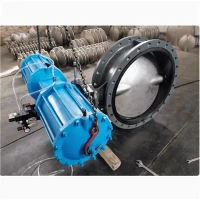
Double-acting rotary actuators-powered by air or oil on both sides of the piston-have become the default choice wherever torque, speed and precise positioning must be combined. Below are the key advantages that explain why engineers specify them for butterfly valves, ball valves and damper drives from offshore platforms to food-processing lines.
1. Full torque in both directions
Because pressure is applied to two separate chambers, the actuator develops identical break-away and re-seat torque regardless of shaft rotation. This bi-directional muscle is essential for metal-seated ball valves that need the same 400 Nm to open against line pressure and to close under high differential.
2. Tight, adjustable positioning
With dual supply lines the control valve positioner can meter air into either side, giving ±0.5° repeatability-something single-acting spring-return units struggle to match once the spring rate changes with temperature or fatigue. The result is better throttling accuracy and lower process variability.
3. Faster stroke times
No spring means no opposing force to overcome during the first 25 % of travel. Users routinely achieve sub-second 90° rotation on 200 mm butterfly valves when running at 6 bar supply, a speed impossible with a spring-return actuator of the same size.
4. Safety without springs
Springs are a mechanical wear item; remove them and you remove a common failure mode. In safety-critical loops, dual-supply actuators can be fitted with volume tanks or quick-exhaust valves to meet SIL 2 or SIL 3 trip times while remaining spring-free, an option not available in single-acting designs.
5. Compact footprint
For a given torque output, a double acting rotary actuator is typically 25 % shorter face-to-face than its spring-return cousin because no axial space is lost to the compression spring pack. This matters on skids where every centimetre counts.
6. Lower air consumption over life
Although both chambers are pressurized, the total air per cycle is lower than the continuous bleed required to keep a spring-return unit "ready." Over a million cycles the energy saving can exceed 15 %, cutting compressor load and operating cost.
7. Easy manual override
Most models allow a hand-wheel or hydraulic hand-pump to be inserted between the chambers, letting operators jog the valve without disturbing the automation system-handy during commissioning or power outages.
8. Wide media compatibility
Standard aluminum or carbon-steel housings work from -40 °C to 80 °C, while stainless-steel or epoxy-coated variants handle sour gas, seawater and aggressive chemicals common in chemical and marine service.
Taken together, these benefits-balanced torque, precise control, speed, safety and life-cycle economy-make double acting rotary actuators the smart default for any quarter-turn valve that must open quickly, close tightly and modulate accurately year after year. If you need to contact us Wuxi Xinming Auto-Control Valves Industry Co., Ltd.