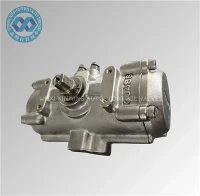
Just last week, I was on our shop floor at WUXI XINMING AUTO-CONTROL VALVES INDUSTRY CO., LTD., watching a maintenance team struggle to align a pneumatic diverter valve. They had bought a standard 90-degree actuator and bolted on an external 2:1 gear ratio box to force a 180-degree stroke. The result? Massive mechanical backlash, severe overshooting, and a valve that jammed exactly in the middle of the switch.
They tried to force a square peg into a round hole. When you need a half-turn, you need a purpose-built 180 degree pneumatic actuator.
As an engineer who spends half my time designing these units and the other half troubleshooting them in the field, I've seen too many projects fail because buyers treat a 180-degree actuator exactly like a 90-degree one. It's not. The physics, the air volume, and the mechanical stresses are completely different.
If you are sourcing a 180-degree rotary actuator for a diverter, 3-way ball, or plug valve, here are the 10 critical factors you must evaluate before placing an order.
1. Ditch the "Hacked" 90-Degree Setup
Never buy a 90-degree actuator with an external multiplier gear to achieve 180 degrees. The external linkage introduces backlash, wear, and alignment drift. Always specify a true 180-degree rack-and-pinion actuator with an extended rack and pinion designed for a seamless half-turn.
2. Calculate the Mid-Stroke (Crossover) Torque
This is the number one reason 180-degree actuators fail in the field. When a 3-way L-port valve rotates, the solid side of the ball blocks the flow exactly at the 90-degree midpoint. This creates a massive torque spike. If you size the actuator based only on the start and end torque, it will stall in the middle of the pipe. Always ask your valve supplier for the crossover torque and apply a 25% safety margin.
3. Demand Independent, Dual-Point Adjustment Stops
A 180-degree valve has three critical positions: 0°, 90°, and 180°. If the midpoint is off by even two degrees, your flow paths won't align, causing severe turbulence. Ensure the actuator has independent external stop bolts so your team can fine-tune the 90° crossover and the 180° end position without opening the cylinder.
4. Size Your Air Supply for Double the Volume
A 180-degree actuator has a much larger internal cylinder volume because the rack travels twice as far. If you use the same small air lines and quick-exhaust valves you used for your 90-degree valves, the 180-degree unit will cycle painfully slow. Upsize your solenoid valves and air tubing to handle the increased air consumption.
5. Verify Fail-Safe (Spring Return) Availability
Packing enough spring force to return a 180-degree stroke requires massive, heavy spring cartridges. Not all manufacturers actually offer a true spring-return 180-degree model; some will just tell you it's "double-acting only." If your process requires a fail-safe position during an air loss, confirm the supplier can physically build it before you order.
6. Require Adjustable End-of-Stroke Cushioning
Because the rack travels further, the piston builds up more momentum by the time it hits the end of the stroke. Without adjustable pneumatic cushioning at both the 0° and 180° ends, the actuator will slam violently, damaging the valve stem and the actuator internals over time.
7. Upgrade Your Limit Switch Box
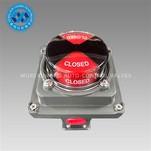
A standard limit switch box with two cams (for 0° and 90°) is useless here. You need a specialized 3-position feedback box that can accurately signal the control room when the valve is at 0°, 90°, and 180°. Don't let a cheap accessory ruin a premium actuator.
8. Confirm the ISO 5211 Mounting Pad
On-site machining is a nightmare. Ensure the actuator's bottom mounting flange strictly adheres to ISO 5211 standards so it drops perfectly onto your valve's top mount without needing custom adapters.
9. Choose the Right Material for the Environment
Just like 90-degree models, the environment dictates the material. If it's a standard indoor water plant, hard-anodized aluminum is perfect. But if it's a coastal desalination plant or a chemical washdown area, specify full 316 stainless steel to prevent internal seizing.
10. Ask for the Actual Torque Curve, Not Just a Model Number
Never buy a 180-degree actuator based purely on a model number. Ask the supplier for the specific torque curve at your minimum plant air pressure. At Wuxi Xinming, we don't just send a price quote; we send a detailed torque calculation sheet proving the actuator won't stall at the crossover point.
Let's Engineer Your Half-Turn Solution
Automating a 180-degree valve is highly specialized. If you are tired of diverter valves jamming at the midpoint or suffering from mechanical backlash, stop guessing.
Send your valve torque data (specifically the crossover torque), medium details, and air pressure to the engineering team at WUXI XINMING AUTO-CONTROL VALVES INDUSTRY CO., LTD. We will provide a free, precise sizing calculation and a purpose-built solution that switches smoothly, every single time.
Contact Xinming today, and let's get your half-turn automation running right the first time.