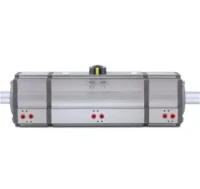
Their system used a diverter mechanism to switch material flow between two production lines. The actuator in use was a standard quarter-turn (90 degree) pneumatic actuator, but the mechanism required a full half-turn movement. Operators had been "forcing" the linkage to achieve the extra travel, which eventually led to misalignment, unstable positioning, and frequent maintenance downtime.
When our engineer arrived on site, the issue was immediately clear: the application was not a 90-degree duty at all. It required a 180 degree pneumatic actuator to properly control the diverter movement.
Situations like this are common in industrial automation, especially in non-valve applications where rotary motion is used for positioning rather than simple open/close control.
At WUXI XINMING AUTO-CONTROL VALVES INDUSTRY CO., LTD., we often emphasize that 180 degree pneumatic actuators are not just "bigger versions" of 90 degree actuators-they are designed for fundamentally different types of motion control tasks.
What Makes a 180 Degree Pneumatic Actuator Different?
A 180 degree pneumatic actuator converts compressed air into a half-turn rotary motion, allowing the output shaft to rotate from 0° to 180°.
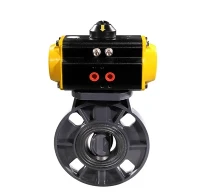
Unlike standard quarter-turn actuators used for ball valves and butterfly valves, these actuators are designed for applications where:
Intermediate positioning is required
Flow direction needs to be switched between two outlets
Mechanical systems require symmetrical half-rotation movement
In practice, the key difference is not just the angle-it is the type of control problem being solved.
1. Material Handling Diverter Systems
One of the most common industrial uses of 180 degree pneumatic actuators is in bulk material handling systems.
We once supported a cement plant project where raw powder needed to be distributed between multiple silos. The diverter gate required a full 180-degree rotation to align the inlet with different discharge points.
A 90 degree actuator simply could not complete the required motion range.
In these systems, 180 degree actuators are used because they provide:
- Precise directional switching
- Stable end-position control
- Reliable repetitive cycling under dust-heavy environments
This makes them ideal for industries like:
- Cement production
- Mining and minerals
- Grain and food bulk handling
- Chemical powder processing
2. Industrial Diverter Valves and Flow Splitters
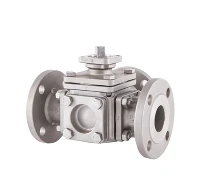
In process industries, 180 degree actuators are frequently installed on diverter valves that control flow routing.
For example, in a chemical blending facility we worked with, a single feed line needed to alternate between two reaction tanks.
Instead of using complex multi-valve systems, the engineering team implemented a mechanically driven diverter controlled by a 180 degree actuator.
The advantage was simplicity:
- One actuator
- One motion cycle
- Two stable flow positions
This reduced system complexity and improved reliability compared to multi-valve sequencing systems.
3. HVAC Air Distribution Dampers
Large HVAC systems, especially in industrial plants, often use rotary dampers to control air distribution.
While many damper systems operate on 90 degree rotation, some specialized air handling units require a 180 degree sweep to fully redirect airflow between different ducts.
In one industrial ventilation project we supported, the actuator was installed in a high-capacity exhaust system where air had to be redirected between internal recirculation and external discharge modes.
A 180 degree pneumatic actuator ensured:
- Smooth airflow transition
- Accurate damper positioning
- Reduced mechanical stress on linkage systems
4. Packaging and Sorting Machinery
Modern automation lines in packaging and logistics often rely on rotary positioning systems rather than simple open/close valves.
We have seen 180 degree pneumatic actuators used in:
- Product sorting diverters
- Conveyor switching arms
- Directional gating systems
In one logistics warehouse project, a high-speed sorting line used a rotary arm controlled by a 180 degree actuator to direct parcels into different conveyor lanes.
The key requirement here was not just movement, but repeatable positioning under high cycle frequency.
5. Special Purpose Mechanical Indexing Systems
Another important application area is mechanical indexing and positioning systems, where equipment must rotate between two defined positions.
Unlike valve automation, these systems often require:
- High repeatability
- Consistent angular positioning
- Robust torque output across full travel
We have encountered such systems in:
- Textile machinery
- Printing equipment
- Industrial testing rigs
In these cases, pneumatic actuation is preferred over electric systems due to speed, simplicity, and resistance to harsh environments.
Why Engineers Choose Pneumatic Over Electric for 180° Systems
From our field experience, engineers often select pneumatic 180 degree actuators because:
- They respond quickly to control signals
- They perform reliably in dusty or humid environments
- They require less electronic complexity
- They offer strong torque in compact sizes
In environments where downtime is costly, simplicity often outweighs precision electronics.
Common Mistakes in Application Design
Despite their advantages, we still see several recurring mistakes:
1. Using 90 Degree Actuators in 180 Degree Systems
This is the most frequent issue and leads to mechanical failure or incomplete motion.
2. Ignoring Load Torque Variation
Many designers underestimate torque changes caused by material buildup, friction, or pressure variation.
3. Improper Linkage Design
Even a correct actuator will perform poorly if mechanical linkage geometry is not designed for full travel.
4. Overlooking End Position Control
In diverter systems, accurate end positioning is critical. Small deviations can disrupt entire process flows.
How We Support Customers in Real Projects
At WUXI XINMING AUTO-CONTROL VALVES INDUSTRY CO., LTD., our approach is not to recommend an actuator immediately.
Instead, we usually start by understanding:
- What motion is required (90° or 180°)
- What mechanical load is involved
- How frequently the system cycles
- What environment it operates in
- What failure mode is acceptable
In many cases, customers initially request a standard quarter-turn solution, but after reviewing the application, we find that a 180 degree actuator is more appropriate for stable long-term operation.
Final Thoughts
180 degree pneumatic actuators are widely used in industrial systems where controlled half-turn motion is required rather than simple open/close valve operation.
They play an essential role in:
- Material handling systems
- Diverter valves
- HVAC airflow control
- Packaging and sorting machinery
- Industrial indexing equipment
From our experience in real engineering projects, the success of a system rarely depends on the actuator alone. It depends on whether the actuator matches the actual motion requirement of the application.
When that alignment is correct, 180 degree pneumatic actuators provide reliable, fast, and maintenance-friendly performance in some of the most demanding industrial environments.