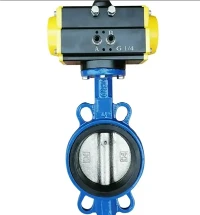
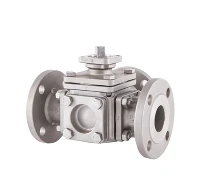
I was on-site last month at a chemical blending facility, watching a maintenance supervisor stare in frustration at a 3-way L-port ball valve. They had just installed a standard 90-degree pneumatic actuator rigged with an external 2:1 gear to force a 180-degree stroke.
"It works fine at the ends," he told me, "but it always jams and trips the air pressure alarm exactly in the middle of the switch."
He was dealing with a classic field nightmare. Automating a 180-degree three-way ball valve isn't just about getting the right rotation angle. It's about understanding the unique fluid dynamics and mechanical resistance of the valve. As a technical engineer at WUXI XINMING AUTO-CONTROL VALVES INDUSTRY CO., LTD., I see this mistake constantly. Here is how you actually choose and size the right 180-degree pneumatic actuator for a 3-way valve, without the guesswork.
1. Size for the "Crossover Torque Spike," Not the Running Torque
This is the single most important rule. When a 3-way L-port ball valve rotates, it has to physically block the flow to switch the flow path from one outlet to the other.
Exactly at the midpoint of the stroke (the 90-degree mark of a 180-degree travel), the solid, un-bored side of the ball is sitting directly in the flow path. The fluid pressure is pushing hard against this solid surface. This creates a massive friction and torque spike-often 30% to 50% higher than the torque required to just turn the valve when it's already aligned.
If you size your 180-degree actuator based on the valve's standard "running torque," it will stall right at the crossover point. Always ask your valve supplier for the crossover torque or mid-stroke torque, and apply a 25% safety margin.
2. Ditch the External Gears for a Purpose-Built 180° Actuator
In the chemical plant I mentioned, the external gear rigging introduced mechanical backlash. When the actuator stopped, the valve was off by 4 degrees, causing severe flow restriction and cross-contamination.
Don't modify a 90-degree actuator. Buy a purpose-built 180-degree pneumatic rack-and-pinion actuator. They feature an extended rack and a longer pinion shaft designed to deliver smooth, consistent torque throughout the entire half-turn, eliminating the dead zones and backlash of external linkages.
3. Demand Independent, Dual-Point Position Stops
A 3-way valve has three critical positions: 0°, 90°, and 180°. If the 90-degree midpoint is off by even two degrees, the valve ports won't align with the pipeline, causing turbulence, cavitation, or trapped media.
When choosing your actuator, check the top-mounted indicator and stop screws. At Xinming, we engineer our 180-degree actuators with independent, dual-adjustment stop bolts. This allows your maintenance team to independently fine-tune the 90° crossover position and the 180° final position on-site, without having to open the actuator housing or disassemble the linkage.
4. Account for the Double Air Volume
A 180-degree actuator has a much larger internal cylinder volume than a 90-degree one because the rack has to travel twice as far. If you use the same small air supply lines and quick exhaust valves you used for your 90-degree valves, the 180-degree actuator will cycle painfully slow.
When specifying your pneumatic control panel, ensure the solenoid valves and air tubing are sized for the higher air consumption of the 180-degree model. If you need a fast cycle time, you might need to increase the air line diameter or add a quick-exhaust valve close to the actuator.
Let's Get Your Diverter Valve Right
Choosing the right actuator for a 3-way ball valve is about respecting the physics of the crossover point. It's not a job for standard catalog guessing.
If you are automating a mixing, diverting, or multi-port flow system, don't leave it to chance. Send your valve torque data, flow medium, and cycle time requirements to the engineering team at WUXI XINMING AUTO-CONTROL VALVES INDUSTRY CO., LTD.
We will provide a free, precise actuator sizing calculation and recommend a purpose-built 180-degree solution that switches smoothly, every single time. Contact Xinming today, and let's engineer your flow control right the first time.