One of their automated dampers wasn't reaching its fully open position. Operators initially suspected a control system issue. The actuator was receiving the correct air signal, air pressure was normal, and the valve itself moved freely when operated manually.
When our engineer reviewed the installation photos, the problem became obvious.
The application required a 180 degree rotation, but a 90 degree pneumatic actuator had been installed.
The actuator wasn't faulty.
It simply wasn't designed for the required movement.
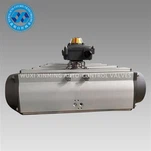
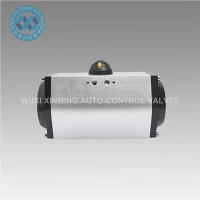
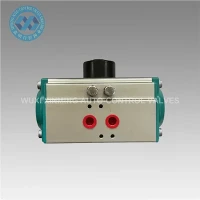
Situations like this are more common than many people think. At WUXI XINMING AUTO-CONTROL VALVES INDUSTRY CO., LTD., customers often ask whether they need a 90 degree pneumatic actuator or a 180 degree pneumatic actuator. While both convert compressed air into rotary motion, they serve different applications and selecting the wrong one can lead to installation problems, operational limitations, and unnecessary costs.
Why Rotation Angle Matters
Before comparing the two actuator types, it's important to understand what the rotation angle actually means.
The rotation angle refers to the total movement of the actuator output shaft from one end position to the other.
For example:
- A 90 degree pneumatic actuator rotates one-quarter turn.
- A 180 degree pneumatic actuator rotates one-half turn.
Although the difference sounds simple, it directly affects which equipment the actuator can operate.
What Is a 90 Degree Pneumatic Actuator?
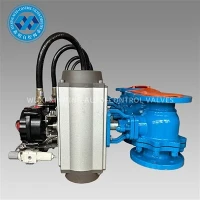
A 90 degree pneumatic actuator is the most common rotary actuator used in industrial valve automation.
It is primarily designed for quarter-turn valves, including:
- Ball valves
- Butterfly valves
- Plug valves
In most industrial facilities, if you see an automated valve opening and closing with a quarter-turn movement, it is likely powered by a 90 degree actuator.
I remember walking through a water treatment plant where hundreds of butterfly valves controlled flow throughout the facility. Nearly every automated valve used a 90 degree rack and pinion actuator because quarter-turn operation was exactly what the process required.
For these applications, 90 degree actuators are simple, reliable, and cost-effective.
What Is a 180 Degree Pneumatic Actuator?
A 180 degree pneumatic actuator is designed to provide a larger rotation range.
Instead of a quarter turn, the output shaft rotates half a turn.
These actuators are commonly used for:
- Dampers
- Diverter valves
- Multi-position flow control devices
- Specialized automation equipment
- Certain process handling systems
Several years ago, we assisted a customer manufacturing bulk material handling equipment. Their diverter mechanism required a full 180-degree movement to direct material flow between two processing lines.
A standard quarter-turn actuator could not achieve the required travel.
In this case, a 180 degree pneumatic actuator was the correct solution.
The Most Important Difference: Application
In practice, application requirements usually determine actuator choice immediately.
90 Degree Actuator Applications
Most commonly used for:
- Ball valves
- Butterfly valves
- Plug valves
- Standard process automation
180 Degree Actuator Applications
Most commonly used for:
- Dampers
- Diverter systems
- Material handling equipment
- Custom automation systems
This is often the first question we ask customers:
"How many degrees does your equipment actually need to rotate?"
The answer usually eliminates one option immediately.
Torque Characteristics
Another important difference involves torque output.
In general, 90 degree pneumatic actuators are optimized for quarter-turn valve operation.
Their torque curve is specifically designed to meet the requirements of ball valves and butterfly valves, where breakaway torque is often highest at the beginning of the stroke.
A 180 degree actuator may have different torque characteristics depending on its internal design.
This becomes especially important when automating equipment that requires consistent torque throughout a longer rotational movement.
Always review the torque curve rather than relying solely on maximum torque values.
Installation Considerations
One lesson we've learned from field experience is that installation space is often overlooked during actuator selection.
During one retrofit project, a customer selected a larger 180 degree actuator without fully considering surrounding equipment.
When installation began, technicians discovered that nearby piping restricted actuator movement.
Additional modifications were required before commissioning could proceed.
Before purchasing any actuator, verify:
Available installation space
Rotation clearance
Valve mounting dimensions
Accessory positioning requirements
A simple site review can prevent significant delays later.
Can a 180 Degree Actuator Replace a 90 Degree Actuator?
Technically, some actuators can be adjusted or mechanically limited to different rotation angles.
However, using a 180 degree actuator for a standard quarter-turn valve is rarely the best solution.
Doing so may result in:
- Unnecessary cost
- Larger equipment size
- More complicated adjustments
- Reduced installation efficiency
For standard ball valves and butterfly valves, a dedicated 90 degree pneumatic actuator is usually the preferred option.
A Real Project Lesson
One project still stands out in my memory.
A customer was upgrading an older production line and replacing several actuators.
The maintenance team assumed all rotary actuators on the site were interchangeable because they looked similar externally.
During installation, one actuator repeatedly failed to achieve the required travel.
After reviewing the equipment drawings, we discovered that the original actuator had been a 180 degree model while the replacement was a standard 90 degree unit.
The difference wasn't immediately visible from the outside.
But operationally, it made all the difference.
Once the correct actuator was installed, the system operated exactly as intended.
How We Help Customers Choose
At WUXI XINMING AUTO-CONTROL VALVES INDUSTRY CO., LTD., actuator selection begins with understanding the application rather than recommending a product immediately.
We typically ask:
- What equipment is being automated?
- What rotation angle is required?
- What torque is needed?
- Is fail-safe operation required?
- What are the environmental conditions?
These answers help determine whether a 90 degree or 180 degree actuator is the better fit.
Final Thoughts
Although they may appear similar externally, 90 degree and 180 degree pneumatic actuators are designed for different operational requirements.
A 90 degree pneumatic actuator remains the standard choice for most ball valves, butterfly valves, and plug valves.
A 180 degree pneumatic actuator is typically selected for dampers, diverter systems, and specialized automation equipment requiring greater rotational travel.
From our experience supporting valve automation projects across multiple industries, the most successful installations begin with understanding the required movement before selecting the actuator.
Because in many cases, the difference between reliable operation and costly troubleshooting is simply a matter of choosing the correct rotation angle from the start.