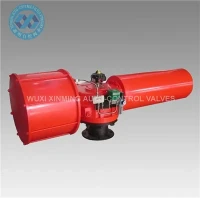
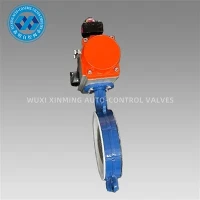
Last month, a maintenance manager from a bulk grain processing plant walked onto our shop floor at WUXI XINMING AUTO-CONTROL VALVES INDUSTRY CO., LTD., looking completely exhausted. He dragged in a battered, modified 90-degree pneumatic actuator that was rigged up with a messy external gear linkage.
"We're trying to automate a pneumatic diverter valve that needs to swing 180 degrees to route grain to different silos," he explained. "We tried using a standard 90-degree actuator with a 2:1 external gear to double the stroke. But the backlash is terrible, the valve overshoots, and it keeps jamming at the midpoint."
He was trying to force a square peg into a round hole. This is a classic field mistake. When you need a half-turn, you don't hack a quarter-turn actuator with external gears; you use a purpose-built 180-degree pneumatic actuator.
As an engineer who spends half my time designing these units and the other half watching them run in the field, let me break down exactly what this equipment is, how it actually works, and why it solves problems that standard actuators just can't handle.
What Exactly Is a 180 Degree Pneumatic Actuator?
Simply put, it is a pneumatic rotary actuator specifically engineered to deliver a precise 180-degree rotation (a half-turn) in a single, smooth stroke.
While a standard rack-and-pinion actuator rotates 90 degrees, a 180-degree version uses an extended rack and a specially machined pinion, or sometimes a dual-cylinder setup, to achieve double the rotation without losing torque or precision. It is the go-to solution for automating 180-degree ball valves, plug valves, diverter valves, and mechanical dampers.
How Does It Work? (The Mechanics)
Don't let the extra rotation fool you; the core physics is still beautifully simple compressed air. Here is what happens inside the housing when you hit the push-button:
1. The First 90 Degrees: Compressed air enters Port A and pushes against the piston. The piston pushes the extended rack, which engages the pinion gear, rotating the output shaft exactly 90 degrees.
2. The Second 90 Degrees: As the air continues to flow (or shifts via a 3-position solenoid valve), the rack keeps traveling along its extended track. The pinion keeps turning, delivering the second 90 degrees. Total rotation: 180 degrees.
3. The Return Stroke: When air is vented and supplied to the opposite side (or when the springs return it, in a fail-safe design), the rack reverses, smoothly unwinding the shaft back to the 0-degree starting position.
The Engineer's Secret: It's All About the Adjustment Stops
Here is something most catalogs won't tell you. In a 180-degree actuator, you aren't just adjusting the start and end points. You have to adjust the midpoint.
During a recent commissioning for a chemical diverter valve, we had to independently adjust the mechanical stop for the first 90 degrees, and then the mechanical stop for the final 180 degrees. If the 90-degree midpoint is off by even two degrees, the valve won't align perfectly with the secondary pipeline, causing severe turbulence and wear. At Xinming, we design our 180-degree actuators with dual, independent external adjustment bolts so our clients can fine-tune both the 90° and 180° positions on-site without opening the cylinder.
Real-World Applications: Where Do We Use Them?
You won't see these on standard water pipes. They are specialized tools for specific jobs:
Pneumatic Conveying Diverter Valves: Routing powders, grains, or plastics from one pipeline to another. The 180-degree sweep ensures a flush, seamless transition without dead legs where material could get trapped.
Cooling and Heating Mix Valves: In HVAC or industrial processing, special 180-degree plug valves blend hot and cold media. The actuator needs that exact half-turn to modulate the mix.
Mechanical Linkages and Manipulators: On automated packaging lines, we often use 180-degree actuators to physically flip or rotate heavy products on a conveyor belt.
An Honest Warning: Watch the "Mid-Stroke Torque Dip"
I always tell my clients: a 180-degree actuator is fantastic, but you must size it correctly. Because the rack is longer, the air volume is larger, and the torque curve can sometimes experience a slight "dip" or drop in the middle of the stroke (around the 90-degree mark) due to friction and air dynamics.
If you size the actuator based only on the start and end torque, the valve might stall in the middle of the pipe. At WUXI XINMING AUTO-CONTROL VALVES INDUSTRY CO., LTD., our engineering team specifically calculates the mid-stroke torque to ensure the actuator has enough muscle to push through the entire 180-degree sweep without hesitation.
Let's Engineer Your Half-Turn Solution
If you are struggling with a diverter valve, a 180-degree plug valve, or a mechanical linkage that keeps failing, stop trying to modify standard 90-degree actuators.
Send your valve torque curve, the required cycle time, and the medium details to our engineering team. We will provide a free, precise sizing calculation for a true 180-degree pneumatic actuator that fits your pipeline perfectly.
Contact WUXI XINMING today, and let's get your half-turn automation running smoothly and reliably.