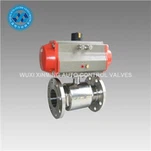
A ball valve can generally handle high - viscosity fluids, but there are several factors to consider.
The design of the ball valve provides some advantages for high - viscosity fluids. The full - bore design, where the ball has a hole through it that is nearly the same diameter as the pipe, allows for a relatively unobstructed flow path. When the valve is fully open, high - viscosity fluids can pass through with less resistance compared to some other valve types with more complex internal geometries.
However, there are also challenges. When the valve is in a partially open position, the high - viscosity fluid may have difficulty flowing smoothly. The spherical shape of the ball and the way the flow area changes as the ball rotates can lead to turbulent flow and increased pressure drop. This is because high - viscosity fluids do not respond as easily to changes in the flow path as lower - viscosity fluids.
In addition, the torque required to operate the valve can be significantly higher when dealing with high - viscosity fluids. The fluid's resistance to flow can make it more difficult to rotate the ball. To handle such fluids effectively, a stronger actuator may be needed to provide sufficient force to open and close the valve. Overall, with the right design considerations and appropriate actuator selection, a ball valve can be a viable option for handling high - viscosity fluids in many applications such as in the food and chemical industries.
If you need a High-Quality Ball Valve, Please contact xinming Auto-Control Valves Industry for further questions.