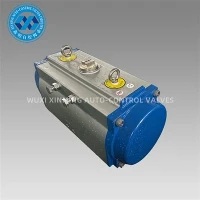
The efficiency of a Scotch Yoke Pneumatic Actuator can be measured through several key methods.
One important aspect is the mechanical efficiency. It is determined by the ratio of the useful output work to the input work. The useful output work is usually measured in terms of the torque generated and the angular displacement of the output shaft. The input work is related to the pressure and volume of the compressed air supplied to the actuator. To calculate this, you need to know the force exerted by the piston (which depends on the air pressure and piston area) and the stroke length of the piston. The efficiency can then be found by comparing the work done in rotating the output shaft (torque x angular displacement) to the work done by the air pressure on the piston (force x stroke length).
Another factor to consider is volumetric efficiency. This measures how effectively the actuator uses the compressed air volume. It is calculated by comparing the actual volume of air needed to achieve a certain output motion to the theoretical volume of air that should be required without any losses. Losses can occur due to air leakage, incomplete filling or emptying of the chambers, and the compressibility of air.
Energy losses due to friction also play a role in efficiency measurement. Friction in the Scotch Yoke mechanism, piston - cylinder interface, and bearings can cause a significant portion of the input energy to be dissipated as heat. By measuring the temperature rise during operation or estimating the frictional forces, the impact of friction on efficiency can be quantified. Overall, a comprehensive evaluation of these factors provides a more accurate measure of the efficiency of a Scotch Yoke Pneumatic Actuator.
If you need a High-Quality Scotch Yoke Pneumatic Actuator Measured, Please contact xinming Auto-Control Valves Industry for further questions.