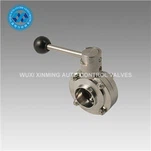
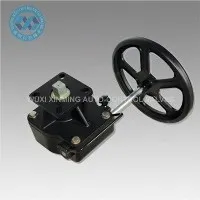
How does a pneumatic actuator work? When the compressed air enters the pneumatic actuator from the A nozzle, the gas pushes the double piston to move linearly to both ends (cylinder head end), and the rack on the piston drives the gear of the rotating shaft to rotate counterclockwise by 90C, and the valve is opened. . At this time, the gas at both ends of the pneumatic actuator valve is discharged with the nozzle B.
On the contrary, when the compressed air enters the pneumatic button from the B nozzle and becomes the two ends of the actuator, the gas pushes the double plug to move linearly to the middle, and the rack on the piston drives the rotating shaft to rotate the gear 90C clockwise, and the valve is closed. At this time, the gas in the middle of the pneumatic actuator is discharged with the A nozzle. The above is the standard transmission principle. According to the needs of users, the pneumatic actuator can be installed in the opposite transmission principle to the standard type, that is, the valve is opened by turning the shaft clockwise, and the valve is closed by turning counterclockwise.
The single-acting (spring return type) pneumatic actuator A nozzle is the air inlet, and the B nozzle is the exhaust hole (the B nozzle should be equipped with a muffler). The inlet of the nozzle A is to open the valve, and the valve is closed by the spring force when the gas is cut off.