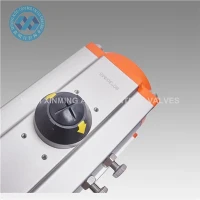
Selecting the right single-acting rotary actuator is a pivotal decision for designers and engineers building efficient pneumatic systems. Unlike its double-acting counterpart, which uses air pressure for movement in both directions, a single-acting actuator relies on air pressure in one direction and a mechanical spring to return to its default position. This fundamental difference creates unique advantages-primarily failing safe to a known position in the event of air pressure loss-but also introduces specific selection criteria. Making the correct choice ensures not only functional reliability but also optimal safety and cost-efficiency for applications like emergency shut-offs, clamping, or safety venting.
Step 1: Analyze Your Application's Core Demands
The selection process begins with a clear understanding of your system's non-negotiable requirements.
- Fail-Safe Position: The defining feature of a single-acting actuator. You must determine the required fail-safe state: spring-extend (normally extended) or spring-retract (normally retracted). This is dictated by safety logic-should the valve fail open or closed if pressure is lost?
- Torque Requirements: Calculate the torque needed to move the load. Crucially, you must evaluate the torque in both directions. The available air pressure must provide enough force to overcome both the load and the opposing spring force during its powered stroke. The spring alone must provide sufficient torque to reliably return the actuator to its fail-safe position.
- Duty Cycle & Speed: Consider how frequently the actuator will cycle. Rapid, continuous cycling can lead to spring fatigue over time. Also, note that the return stroke speed is governed by the spring's characteristics and not easily adjustable, unlike the air-driven stroke.
Step 2: Evaluate Key Product Specifications
With your application needs defined, match them against the actuator's technical specifications.
- Torque Curves: Examine the manufacturer's torque curves for both the air stroke and the spring return. Ensure the spring return torque is adequate for your load at all points in its travel, not just at the start or end.
- Spring Fatigue Life: High-quality manufacturers will rate their springs for a certain number of cycles (e.g., 1 million cycles). Select a spring life that far exceeds your expected operational cycles to ensure long-term reliability.
- Construction & Environment: Assess the housing material (e.g., aluminum, stainless steel) for corrosion resistance and the sealing technology (e.g., nitrile, Viton) for compatibility with operational temperatures, potential contaminants, or lubricated/unlubricated air.
Step 3: Make a Balanced and Informed Decision
The final choice involves weighing trade-offs and planning for the future.
- The Space & Force Trade-off: Single-acting actuators are typically larger than equivalent double-acting models because they must house the return spring. Ensure you have adequate space in your design.
- Total Cost of Ownership: While sometimes simpler in plumbing (requiring only one air supply line), the mechanical spring is a wear component. Factor in the potential long-term need for spring replacement or maintenance versus the critical safety benefit it provides.
- Vendor Expertise: Partner with a supplier that provides clear technical data, spring life ratings, and application support. Their guidance is invaluable for navigating the unique considerations of spring-return mechanics.
In summary, selecting a single-acting rotary actuator requires a focused analysis on fail-safe behavior and a dual assessment of torque from both air and spring. By prioritizing spring performance and lifecycle as much as air-driven power, you ensure a choice that guarantees safety, reliability, and precision for your critical applications.
For expert guidance in selecting the perfect single-acting rotary actuator for your specific safety-critical or positioning application, our engineering team is ready to assist.