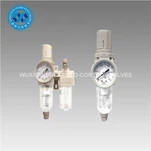
An air filter regulator (AFR) is a device used to regulate and filter the flow of compressed air in various applications. It consists of two main components: the filter and the regulator.
The filter component is responsible for removing contaminants, such as dust, dirt, oil, and water droplets, from the compressed air. It typically contains a filter element made of porous material, which traps these particles as the air passes through. The filter element needs to be periodically cleaned or replaced to maintain its effectiveness.
The regulator component controls the pressure of the compressed air that passes through the AFR. It ensures that the downstream pressure remains constant, regardless of any fluctuations in the upstream pressure. The regulator usually consists of a diaphragm, a spring, and an adjustable pressure setting. The diaphragm senses the downstream pressure and adjusts the spring tension accordingly, allowing the desired pressure to be maintained.
The principle of operation for an AFR is the compressed air enters the AFR through an inlet port. It first passes through the filter element, where contaminants are removed. Then, the air reaches the regulator component, where the pressure is adjusted to the desired level. Finally, the filtered and regulated air is released through an outlet port, ready for use in the downstream system.
The AFR is commonly used in pneumatic systems to ensure that the compressed air is clean and at the appropriate pressure for various applications. It helps protect downstream equipment from damage caused by contaminants and prevents pressure-sensitive components from being subjected to excessive or insufficient pressure.