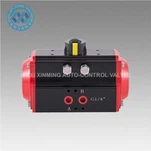
Pneumatic actuators, also known as pneumatic actuators or pneumatic devices, are actuators that use compressed air source pressure to drive open, close, or adjust valves. They are mainly composed of cylinders, pistons, gear shafts, end caps, seals, and screws.
Pneumatic actuators are generally used in conjunction with various types of valves, including opening indication, travel limit, solenoid valve, positioner, pneumatic components, manual mechanism, signal feedback, and other components. The opening and closing of the valve, how much it opens and how much it closes, are all controlled by compressed air.
Pneumatic actuators can be divided into single-acting and double-acting according to the form of action. Double-acting actuators are air-on and air-off, that is, the ventilation is opened, and the ventilation is closed. When the air source is lost, there is no action, and stays in place.
The single-acting actuator has the function of spring return, generally, there are normally closed type and normally open type, that is, the ventilation is opened, and when the air source is lost, it will automatically reset to the initial state. Double-acting actuators are mainly air-on-air-off type, that is, the valve needs to use the air source whether it is opened or closed, usually manifested as open ventilation, closed ventilation, loss of air source, the valve remains in the state at that time, and the air source is reconnected After that, the valve can continue to work. The single-acting actuator has the function of spring return. Normally open and normally closed can be selected according to the working conditions. Case 1: The ventilation is opened, and when the air source is lost, it will automatically reset to the initial closed state. Case 2: The ventilation is turned off, and when the air source is lost, it will automatically reset to the initial open state.
Double-acting pneumatic actuators are generally used in working conditions with low leakage requirements, while single-acting pneumatic actuators are used more in dangerous working conditions. Close or open quickly. In terms of price, single-acting pneumatic actuators will be higher than double-acting.