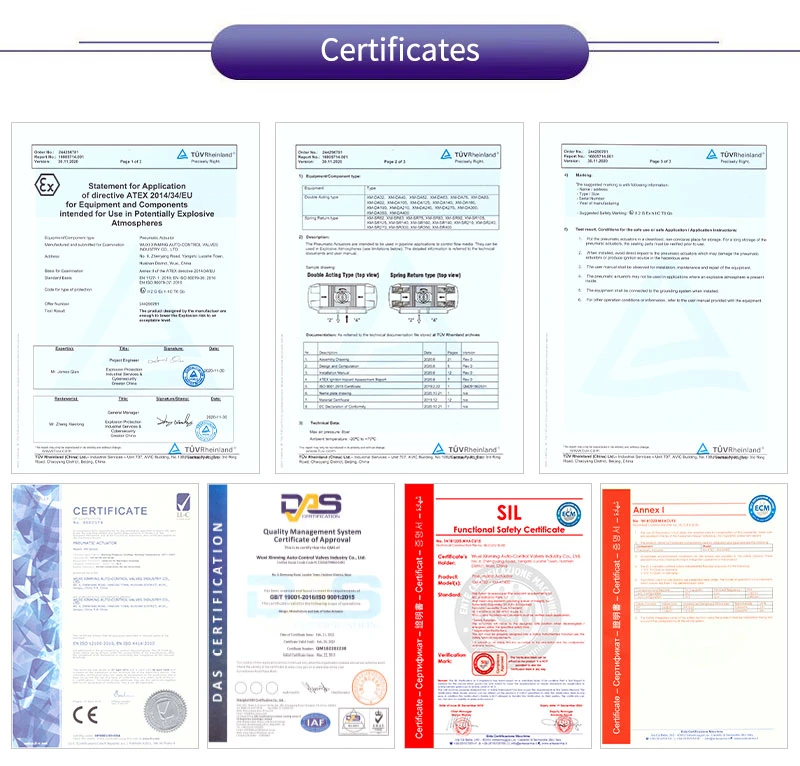
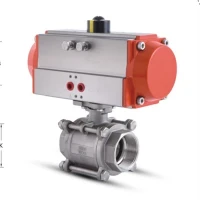
Reliable Pneumatic Actuators are reliable pneumatic actuators, and their working principles are mainly based on the following aspects:
1. Air pressure generates power
The power source of pneumatic actuators is compressed air. After being compressed by the compressor, the air has a higher pressure and energy and is transported to the pneumatic actuator. This compressed air is like "energy reserves" and provides a power basis for the action of the actuator.
2. Control the direction of air flow
Pneumatic actuators control the flow direction of compressed air through various control valves. For example, the reversing valve can change the channel of the air flow so that the compressed air enters different chambers of the actuator in the required direction, thereby realizing different actions of the actuator, such as the reciprocating motion of the piston and the rotation of the shaft.
3. Conversion and transmission of force
In a cylinder-type pneumatic actuator, when compressed air enters the chamber on one side of the cylinder, it will generate pressure on the piston. According to Pascal's law, the pressure will act evenly on the surface of the piston, thereby generating a thrust to move the piston in the cylinder. This thrust is transmitted through the piston rod, which can drive external mechanical devices, such as the opening and closing of valves, the movement of mechanical arms, etc.
In the vane-type pneumatic actuator, compressed air enters and pushes the vane, causing the shaft to produce rotational motion, thereby outputting torque and driving the equipment that requires rotational motion.
4. Motion control
By adjusting the pressure and flow of compressed air, the movement speed and force of the pneumatic actuator can be accurately controlled. For example, increasing the air flow can speed up the piston movement and increase the actuator's action frequency; increasing the air pressure can increase the thrust of the piston or the torque of the vane, so that the actuator can overcome greater resistance and complete more difficult tasks.
5. Feedback and regulation
Some advanced pneumatic actuators are also equipped with feedback devices such as position sensors, which can monitor the movement position and state of the actuator in real time and feed this information back to the control system. The control system compares the feedback signal with the preset value and then adjusts the parameters, such as the opening of the control valve, to achieve precise control and regulation of the pneumatic actuator, ensuring its reliability and accuracy.
If you are interested in learning more about the efficacy and role of Aromatherapy candles, please visit www.xmvalveactuator.com!