In the industrial world, butterfly valves play a crucial role in controlling the flow of fluids in various pipelines. As a trusted butterfly valve supplier, I often encounter customers who are confused about the differences between standard and customized butterfly valves. In this blog, I will delve into the nuances between these two types of valves to help you make an informed decision for your specific needs.
Standard Butterfly Valves
Standard butterfly valves are mass - produced products that adhere to well - established industry standards. These standards are set by organizations such as the American National Standards Institute (ANSI), the International Organization for Standardization (ISO), and the European Committee for Standardization (CEN).
One of the primary advantages of standard butterfly valves is their availability. Since they are mass - produced, they are readily available in the market. You can easily find a wide range of sizes, materials, and pressure ratings. For example, a common standard size for a butterfly valve might be 2 inches, 4 inches, or 6 inches, which are widely stocked by suppliers.
The cost of standard butterfly valves is generally lower compared to customized ones. The economies of scale in mass production allow manufacturers to offer these valves at a more affordable price. This makes them an attractive option for projects with budget constraints.
In terms of performance, standard butterfly valves are designed to meet general requirements. They are suitable for most common applications where the flow rate, pressure, and temperature are within the normal operating range. For instance, in a water supply system for a commercial building, a standard butterfly valve can effectively control the flow of water.
However, standard butterfly valves also have their limitations. They may not be the best fit for highly specialized applications. If your project has unique requirements such as extreme temperatures, high - pressure conditions, or the need to handle corrosive fluids, a standard valve might not be sufficient.
Customized Butterfly Valves
Customized butterfly valves, on the other hand, are designed and manufactured to meet specific customer requirements. When a project has unique operating conditions or performance criteria, a customized valve is often the solution.

The first step in the customization process is a detailed consultation with the customer. As a butterfly valve supplier, I work closely with clients to understand their exact needs. This includes factors such as the type of fluid being handled (e.g., corrosive chemicals, abrasive slurries), the operating temperature and pressure, and the specific flow rate requirements.
Based on this information, engineers design a valve that is tailored to the customer's specifications. For example, if a customer needs a valve for a high - temperature application, the valve can be made from special heat - resistant materials. If the fluid is highly corrosive, the valve can be coated with a corrosion - resistant layer.
Customized butterfly valves offer several benefits. They provide a perfect fit for the application, which can lead to improved performance and efficiency. For example, in a chemical processing plant, a customized valve can be designed to handle specific chemicals without the risk of corrosion or leakage.
However, the customization process has its drawbacks. It typically takes longer to manufacture a customized valve compared to a standard one. The design and production process involves more engineering work and quality control checks. Additionally, the cost of a customized valve is usually higher due to the additional design and manufacturing efforts.
Comparing the Two: Design and Construction
The design of standard and customized butterfly valves also differs significantly. Standard valves follow a common design pattern that has been optimized for mass production. They usually have a simple disc - and - stem design, with the disc rotating around a central axis to control the flow. The materials used are typically common and widely available, such as cast iron, carbon steel, or stainless steel.
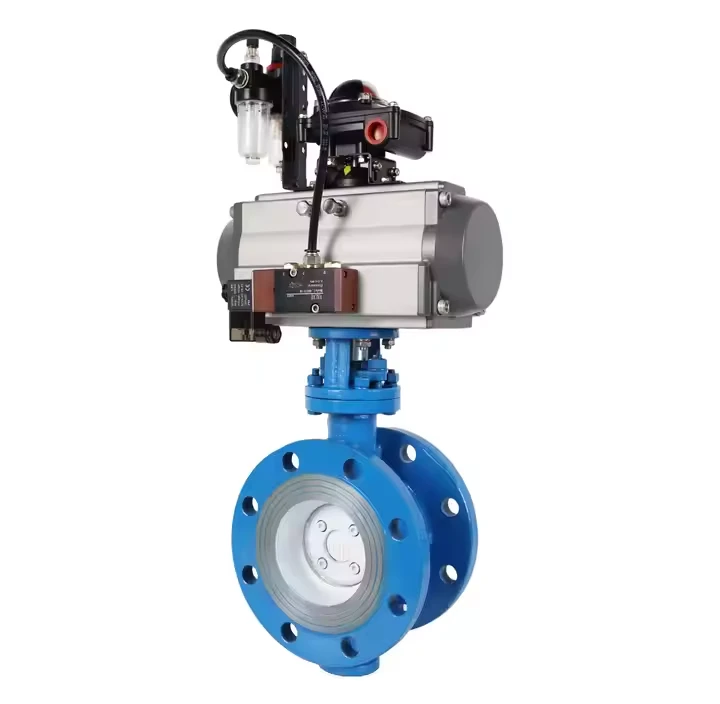
Customized valves, on the other hand, can have more complex designs. For example, a Triple Eccentric Pneumatic Butterfly Valve is a type of customized valve that has three eccentricities in its design. This design allows for better sealing performance, especially in high - pressure applications. The materials used in customized valves can also be more specialized, such as high - nickel alloys for extreme corrosion resistance.
Performance and Functionality
In terms of performance, standard valves are designed to provide reliable and consistent operation under normal conditions. They are suitable for applications where the flow rate and pressure are relatively stable. However, in applications where there are sudden changes in flow or pressure, a standard valve may not be able to respond as effectively.
Customized valves can be engineered to handle a wider range of operating conditions. For example, a Stainless Steel High Temperature Explosion - proof Pneumatic Hard Seal Flanged Butterfly Valve is designed to operate in high - temperature and potentially explosive environments. It has special features such as explosion - proof enclosures and hard - seal designs to ensure safe and reliable operation.
Applications
Standard butterfly valves are commonly used in a variety of general applications. They are found in water treatment plants, HVAC systems, and food and beverage processing. In these applications, the standard valve's performance and cost - effectiveness make it a popular choice.
Customized butterfly valves are often used in industries with more demanding requirements. For example, in the oil and gas industry, customized valves are used in offshore platforms and refineries to handle high - pressure and high - temperature fluids. In the pharmaceutical industry, customized valves are used to ensure the sterility and accuracy of fluid control.
Cost and Lead Time
As mentioned earlier, standard butterfly valves are generally more cost - effective due to mass production. The lead time for standard valves is also shorter, as they are usually in stock or can be quickly manufactured.
Customized valves, on the other hand, are more expensive due to the additional design and manufacturing efforts. The lead time for a customized valve can be several weeks or even months, depending on the complexity of the design.
Conclusion
In conclusion, the choice between a standard and a customized butterfly valve depends on your specific needs. If you have a common application with normal operating conditions and a limited budget, a standard valve is likely the best choice. However, if your project has unique requirements such as extreme temperatures, high - pressure conditions, or the need to handle corrosive fluids, a customized valve is the way to go.
As a butterfly valve supplier, I am committed to providing the best solutions for your valve needs. Whether you need a standard valve or a customized one, I can offer professional advice and high - quality products. If you are interested in learning more about our butterfly valves or would like to discuss a specific project, please feel free to reach out. We are ready to engage in procurement discussions and help you find the perfect valve for your application.