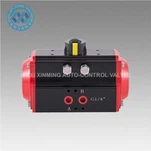
Causes of damage to pneumatic ball valves
Pneumatic ball valves are widely used in the field of coal chemical equipment gasification. Because the operating conditions contain special media such as solid particles, ash, and sulfur, they should achieve wear resistance, corrosion resistance, erosion resistance, anti-scaling and scarring, rapid Opening and closing, frequent movements, and other requirements, together with good sealing, improve the efficiency of the equipment, make it low energy consumption and safe and reliable operation.
1. Analysis of the cause of leakage of the pneumatic ball valve
After a period of time, the valve will not switch in place, jam, etc., the valve will be severely washed, the sealing surface will be damaged, and if it is more serious, the ball and the parts in the valve cavity will be damaged, resulting in internal leakage of the valve; cause the valve to leak.
1.1 Internal leakage of pneumatic ball valve:
According to the inductive analysis of various gasification technologies, media and processes, the ball valve in key parts is affected by the solid content in the medium, and the valve switching frequency is high, which is affected by the saving structure of the valve design flow path, and the pressure difference between the front and rear of the valve. It also becomes larger, resulting in particularly severe valve erosion and wear.
1.2 Leakage of pneumatic ball valve:
The unreasonable design of the valve stem packing structure, the excessive coaxiality of the valve ball and the valve stem, and the unreasonable selection of valve stem materials, etc., cause the valve stem and packing to wear during the opening and closing process, and the matching surface of the valve stem and packing wears. Seriously, the diameter of the valve stem is reduced, and finally, the medium in the valve flow channel leaks along the axial direction of the valve stem.
2. Improvement measures for pneumatic ball valve
2.1. Transformation of inner sealing structure
The hard-sealed ball valve seat adopts a scraping structure design, which makes the ball and valve seat have a self-cleaning function during the opening and closing process, which can effectively avoid the deposition and adhesion of particles between the ball and the valve seat, and ensure that the valve moves smoothly and continuously without blocking; Special structural design is used between the valve seat and the valve body, as well as the main and auxiliary valve seats, and a metal ring is added between the sealing packing to improve the stiffness and toughness of the packing and further effectively prevent impurities from entering the spring cavity behind the valve seat to ensure long-term use of the spring. Work.
2.2 Transformation of the outer sealing structure
The upper and lower end faces of the valve stem are all positioned by bearings, and the valve stem plays a relative rotation and guiding role, ensuring the coaxiality requirements of the valve stem and the sphere. The preload is designed as a live load method, and the sealing effect is better, which can ensure the service life of the sealing material.
2.3 Use new technology and new materials:
According to different working conditions, the valve ball can be made of ceramic-metal composite ball or surface sprayed with tungsten carbide, zirconium carbide and other materials.
Through the above improvement of its inner and outer sealing structure, the wear resistance of the valve sealing surface and the packing sealing function are improved, and the service life of the equipment is extended. The sealing structure of the pneumatic ball valve is relatively reasonable and meets the requirements of working conditions.