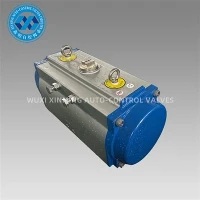
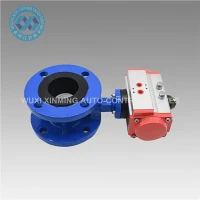
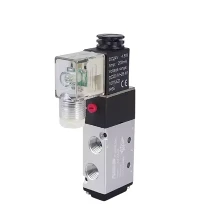
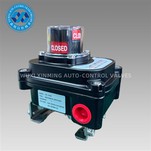
A few years ago, a customer from Southeast Asia contacted us about a valve automation project for a water treatment facility.
The valves had already been purchased. The control system was ready. The installation schedule had been finalized.
Everything looked on track until one question came up:
"Which 90 degree pneumatic actuator should we use?"
At first glance, the answer seemed simple. The project used several 8-inch butterfly valves and a number of ball valves. The customer assumed that selecting an actuator was just a matter of matching the valve size.
A few weeks later, however, some valves were struggling to reach their fully closed position during testing.
The issue wasn't actuator quality.
The problem was actuator selection.
This is one of the most common mistakes we see in the field. Many buyers focus on valve size when they should be focusing on valve torque, operating conditions, and safety margins.
At WUXI XINMING AUTO-CONTROL VALVES INDUSTRY CO., LTD., we help customers automate valves every day, and one lesson remains consistent:
The best actuator selection starts with understanding the application, not the catalog.
Why Valve Size Alone Doesn't Tell the Whole Story
One of the biggest misconceptions in valve automation is that larger valves always require larger actuators.
In reality, two valves of the same size can have completely different torque requirements.
I remember a project involving two 10-inch valves.
One was a soft-seated butterfly valve used in a clean water system.
The other was a metal-seated ball valve operating under higher pressure conditions.
Although both valves shared the same nominal size, the ball valve required significantly more operating torque.
Had we selected the actuators based solely on valve diameter, one of the valves would have been seriously undersized.
Step 1: Determine the Valve Torque
Before selecting any 90 degree pneumatic actuator, the first task is identifying the valve's required torque.
Manufacturers typically provide:
- Breakaway torque
- Running torque
- Seating torque
- Unseating torque
Among these values, breakaway torque often deserves special attention because it is frequently the highest torque point during operation.
In one chemical plant project, accumulated deposits inside the valve increased breakaway torque over time. The original actuator sizing left little safety margin, and after several years the valves became difficult to operate.
A properly selected actuator should account for these real-world changes.
Step 2: Understand the Difference Between Ball Valves and Butterfly Valves
Although both use quarter-turn motion, they behave differently.
Ball Valves
Ball valves generally require:
- Higher breakaway torque
- Strong sealing force
- Larger torque reserve
Process pressure can significantly influence operating torque.
In high-pressure applications, actuator sizing becomes especially important.
Butterfly Valves
Butterfly valves usually require:
- Lower operating torque
- Faster response
- Less actuator output for similar sizes
However, larger butterfly valves can still require substantial torque, particularly in high-flow systems.
Never assume a butterfly valve automatically needs a small actuator.
Step 3: Consider Operating Pressure
One lesson we've learned from years of field support is that operating pressure often changes everything.
A valve tested in a workshop may operate perfectly.
The same valve installed in a live process line may behave very differently.
I remember standing beside a newly commissioned pipeline while operators tested automated valves for the first time.
Under actual system pressure, several valves required noticeably more force to move than they had during factory testing.
Fortunately, adequate actuator sizing margins had been included.
Without that extra capacity, the project could have faced immediate operating issues.
Step 4: Apply a Safety Factor
Experienced engineers rarely size actuators using exact torque values.
Instead, they apply safety factors to compensate for:
- Valve wear
- Process changes
- Friction increases
- Manufacturing tolerances
- Future operating conditions
A small investment in additional torque capacity today can prevent expensive troubleshooting later.
This is particularly important for valves that operate continuously or are difficult to access for maintenance.
Step 5: Decide Between Single Acting and Double Acting
One of the first questions we ask customers is:
"What happens if the air supply fails?"
The answer usually determines actuator type.
Single Acting (Spring Return)
Suitable when fail-safe operation is required.
Typical applications include:
- Emergency shutdown systems
- Safety valves
- Critical process control
If air pressure is lost, the spring automatically drives the valve to its predetermined position.
Double Acting
Ideal when:
- Maximum torque is needed
- Air supply is stable
- Fail-safe function is not required
Double acting actuators often provide higher torque within a more compact package.
Step 6: Evaluate Environmental Conditions
The installation environment affects actuator selection more than many buyers realize.
A few years ago, we supplied actuators for two separate facilities.
One was located indoors in a clean manufacturing plant.
The other sat less than a kilometer from the coastline.
Although the valve specifications were nearly identical, the actuator materials were completely different.
The coastal project required enhanced corrosion resistance due to constant salt exposure.
Environmental conditions should always be part of the selection process.
Step 7: Verify Mounting Compatibility
Nothing slows installation faster than discovering mounting issues on site.
Before purchasing, confirm:
- ISO 5211 mounting standards
- Valve stem dimensions
- Drive shaft compatibility
- Accessory mounting requirements
We have seen projects delayed simply because an actuator and valve interface were not properly checked beforehand.
A few minutes of verification can save days of frustration later.
A Real Lesson from the Field
One project still stands out in my memory.
The customer had purchased actuators from multiple suppliers based primarily on price.
During commissioning, some valves performed well.
Others operated inconsistently.
When we reviewed the project, we discovered that different torque calculation methods had been used throughout the system.
Some actuators had generous safety margins.
Others had almost none.
The result was a valve network with inconsistent reliability.
Eventually, the customer standardized actuator sizing across the facility.
Maintenance became easier, spare parts inventory was simplified, and operating performance improved.
That experience reinforced an important lesson:
Actuator selection is not just about buying a product. It is about ensuring long-term system reliability.
Final Thoughts
Selecting a 90 degree pneumatic actuator for ball valves and butterfly valves involves much more than matching valve size.
The best results come from understanding:
- Valve torque requirements
- Operating pressure
- Safety margins
- Environmental conditions
- Fail-safe requirements
- Mounting compatibility
At WUXI XINMING AUTO-CONTROL VALVES INDUSTRY CO., LTD., we have found that customers who invest time in proper actuator selection almost always experience fewer operational problems and lower lifecycle costs.
A correctly selected actuator may never attract attention once the system is running.
But years later, when the valve continues to open and close reliably every day, that careful selection process proves its value.