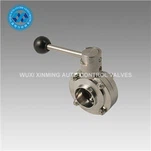
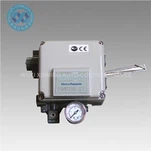
The actuator and adjustment mechanism of the Stainless Steel Pneumatic Actuator is a unified whole, and its actuators are film type, piston type, fork type and rack and pinion type. The piston type has a long stroke and is suitable for occasions requiring large thrust; while the diaphragm type has a small stroke and can only directly drive the valve stem. The fork-type pneumatic actuator has the characteristics of large torque, small space, and the torque curve is more in line with the torque curve of the valve, but it is not very beautiful; it is often used on valves with high torque. The rack-and-pinion pneumatic actuator has the advantages of simple structure, stable and reliable action, and safety and explosion-proof. It is widely used in power plants, chemical industry, oil refining and other production processes with high safety requirements.
working principle
01 When the compressed air enters the pneumatic actuator from the A nozzle, the gas pushes the double piston to move linearly to both ends (the cylinder head end), the rack on the piston drives the gear on the rotating shaft to rotate 90 degrees counterclockwise, and the valve is closed. Open. At this time, the gas at both ends of the pneumatic actuator valve is discharged with the B nozzle.
02
On the contrary, when the compressed air enters the two ends of the pneumatic actuator from the B nozzle, the gas pushes the double plug to move linearly to the middle, the rack on the piston drives the gear on the rotating shaft to rotate 90 degrees clockwise, and the valve is closed. At this time, the gas in the middle of the pneumatic actuator is discharged with the A nozzle.
03
The above is the standard transmission principle. According to the needs of users, the pneumatic actuator can be installed in the opposite transmission principle to the standard type, that is, the valve is opened by turning the shaft clockwise, and the valve is closed by turning counterclockwise. The single-acting (spring return type) pneumatic actuator A nozzle is the air inlet, and the B nozzle is the exhaust hole (the B nozzle should be equipped with a muffler). The inlet of the nozzle A is to open the valve, and the valve is closed by the spring force when the gas is cut off.
Actuator classification
1 Pneumatic actuator
2 electric actuators
3 Hydraulic actuators can also be divided into
1. Double acting actuator
2. Single-acting actuator
Internal Curve Pneumatic Actuator
This product introduces and adopts the latest scientific research achievements: the pneumatic inner curve motor as the power element, which is a new type of multi-turn drive device which is different from the general pneumatic actuator. It is used to control the opening and closing and opening adjustment of gate valves, globe valves, butterfly valves, etc., which greatly reduces the labor intensity of on-site operators and improves labor efficiency. It can be widely used in oil refining, chemical industry, and other devices that require a high degree of automation, in flammable and explosive environments and other devices with harsh working conditions.