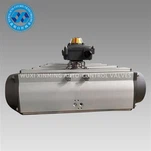
Choosing the right Pneumatic Actuators requires evaluating key factors that align with specific application needs, ensuring long-term reliability and optimal performance.
Load and Force Requirements
First, assess the load the actuator must move and the force needed for the task. Heavier loads or tasks requiring strong clamping need Pneumatic Actuators with higher force output-such as piston cylinders. Milder tasks like handling fragile parts call for lower-force options like diaphragm actuators. Mismatched force can lead to slow movement, premature wear, or failure to complete tasks.
Motion Type
Determine the required motion-linear or rotational. Linear motion (e.g., pushing or lifting) suits piston cylinders or diaphragm actuators. Rotational motion (e.g., turning valves or robotic joints) needs rack-and-pinion or vane actuators. Selecting the wrong motion type will disrupt operations and reduce the efficiency of Pneumatic Actuators.
Environmental Conditions
Consider the operating environment. High temperatures, moisture, or dust require actuators with robust protection-such as corrosion-resistant coatings or sealed designs. Clean environments like food processing need Pneumatic Actuators with contamination-resistant parts to comply with hygiene standards. Ignoring environmental factors can cause rapid damage and shorten service life.
Control Precision Needs
Evaluate how precise the motion control must be. Tasks like micro-assembly demand high-precision actuators with minimal motion error. Routine tasks like basic valve operation can use standard-precision models. Choosing an actuator with too little precision leads to operational errors, while excessive precision increases unnecessary costs.
Compatibility with Existing Systems
Ensure the selected Pneumatic Actuators are compatible with existing air supply systems, control valves, and mounting setups. Check if the actuator's air pressure requirements match the factory's compressed air supply. Verify mounting dimensions to fit existing equipment. Incompatibility will require costly modifications and delay integration.
If you're interested in learning more about pneumatic actuators and other related information, please feel free to contact us! With years of industry experience, we sincerely invite you to create a better future together.