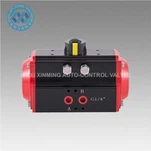
First, the torque required to open and close the valve is determined. Under normal conditions of use, the recommended safety factor is 15-20%. The safety value increases according to the fluid medium used by the valve. Add 20% safety value to clean lubricating medium; increase 25% safety value to water vapor or non-lubricating liquid medium; increase 40% safety value to non-lubricating mud liquid medium; increase 80% safety value to non-lubricating granular medium.
When selecting a dual pneumatic actuator, according to the torque value and air source pressure calculated above, an accurate at model can be obtained by searching the torque table of the dual pneumatic actuator.
When selecting a single pneumatic actuator, according to the torque value calculated above and the pressure of the air source used, calculate the torque at the end of the spring return column (the torque should be greater than the torque calculated above), and then an accurate SR model can be obtained. For example, if the air supply pressure is 0.4MPa, the torque should be controlled at 165n according to the above calculation. As can be seen from the table, the end of the spring return is close to 171n. M. Looking to the left, the actuator model is SR160 (installed with 10 sets of springs).
Note: In the SR single pneumatic output torque table, the "end" torque of the spring return is the valve closing torque, and the "start" torque of the spring return is the valve opening torque. The initial torque of the corresponding air source pressure is the valve closing torque, and the end torque of the air source pressure is the valve opening torque.