A few years ago, I received a call from a maintenance supervisor at a water treatment plant.
One of their automated butterfly valves had stopped reaching the fully closed position. Operators initially suspected the valve itself had failed. The valve was removed, inspected, and found to be in good condition. Attention then turned to the actuator.
When our engineer arrived on site, the problem turned out to be surprisingly simple. The replacement actuator that had been installed during a previous shutdown was not properly adjusted for the valve's required quarter-turn operation. As a result, the valve never achieved its full 90-degree rotation.
That incident may sound unusual, but it highlights a common reality in industrial automation: many people work with 90 degree pneumatic actuators every day without fully understanding how they operate or why they are so widely used.
At WUXI XINMING AUTO-CONTROL VALVES INDUSTRY CO., LTD., we regularly help customers select, install, and troubleshoot pneumatic actuators for valve automation systems. One of the most frequently asked questions we receive is:
What exactly is a 90 degree pneumatic actuator, and how does it work?
What Is a 90 Degree Pneumatic Actuator?
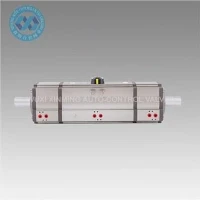
A 90 degree pneumatic actuator is a device that converts compressed air into rotary motion.
As its name suggests, the actuator rotates its output shaft through a quarter turn, or 90 degrees, to open or close a valve.
These actuators are commonly used with:
- Ball valves
- Butterfly valves
- Plug valves
- Damper systems
Unlike multi-turn actuators used on gate valves or globe valves, a 90 degree actuator is specifically designed for applications where a quarter-turn movement controls the flow path.
If you've ever watched a butterfly valve move from fully closed to fully open, you've seen a 90-degree rotation in action.
How Does a 90 Degree Pneumatic Actuator Work?
Although different actuator designs exist, most industrial 90 degree pneumatic actuators use a rack and pinion mechanism.
Inside the actuator housing are two pistons positioned opposite each other.
When compressed air enters the actuator chamber:
1. Air pressure pushes the pistons outward.
2. The pistons drive two gear racks.
3. The racks rotate a central pinion gear.
4. The pinion rotates the output shaft.
5. The valve stem turns exactly 90 degrees.
When air is supplied to the opposite chamber, the process reverses and the valve returns to its original position.
The movement happens quickly, reliably, and with enough torque to operate industrial quarter-turn valves.
A Real Factory Experience
One project still stands out in my memory.
A customer operating a food processing facility was upgrading several manual butterfly valves to automatic operation. Production managers wanted faster process control and reduced manual intervention.
During installation, everything looked perfect.
The valves opened.
The valves closed.
The control signals responded correctly.
However, several weeks later operators reported inconsistent flow rates in one production line.
After inspection, we discovered that one actuator had not been properly aligned with the valve stem during installation. The actuator was reaching its mechanical stop, but the valve disc was stopping slightly short of its fully open position.
Standing on the production floor watching operators troubleshoot what appeared to be a process issue, it became clear how important proper actuator setup is.
The actuator itself wasn't faulty.
The installation was.
After adjustment, the valve immediately returned to normal operation.
Experiences like this remind us that understanding how a pneumatic actuator works is just as important as choosing the right model.
Why Are 90 Degree Pneumatic Actuators So Popular?
There are several reasons why quarter-turn pneumatic actuators dominate valve automation projects.
- Simple Mechanical Design
Rack and pinion actuators contain relatively few moving parts, making them reliable and easy to maintain.
- Fast Operation
In many industrial processes, valves need to open and close quickly.
Pneumatic actuators can complete a full 90-degree stroke in seconds.
- Suitable for Harsh Environments
Unlike electric actuators, pneumatic systems can operate safely in many hazardous areas where electrical equipment may require additional protection.
- Easy Integration
Most modern actuators are designed to comply with ISO mounting standards, making installation on ball valves and butterfly valves straightforward.
- Single Acting vs Double Acting 90 Degree Pneumatic Actuators
When customers contact us, they are often unsure which actuator type they need.
- Single Acting
Compressed air drives the actuator in one direction.
Internal springs return the actuator when air pressure is removed.
Typical applications include:
- Emergency shutdown systems
- Safety-critical valves
- Fail-open or fail-close applications
Double Acting
Compressed air powers both opening and closing movements.
Advantages include:
- Higher torque output
- More precise control
- No spring package required
These actuators are commonly found in general industrial automation systems.
- Common Mistakes We See During Selection
After years of supporting valve automation projects, several mistakes appear repeatedly.
Choosing Based Only on Valve Size
A larger valve does not always require a larger actuator.
Actual valve torque should always be calculated.
Ignoring Air Supply Conditions
Insufficient air pressure can significantly reduce actuator performance.
Overlooking Environmental Factors
Outdoor installations, chemical exposure, and coastal environments may require different actuator materials.
Incorrect Travel Adjustment
Even a small deviation from the intended 90-degree stroke can affect valve sealing and process performance.
How We Help Customers Select the Right Actuator
At WUXI XINMING AUTO-CONTROL VALVES INDUSTRY CO., LTD., actuator selection usually starts with understanding the application rather than recommending a product immediately.
Our engineers typically ask:
- What type of valve is being automated?
- What is the required operating torque?
- Is a fail-safe function needed?
- What are the environmental conditions?
- How frequently will the valve cycle?
The answers often determine the best actuator configuration more accurately than any catalogue specification alone.
Final Thoughts
A 90 degree pneumatic actuator may appear to be a simple device, but it plays a critical role in modern valve automation systems.
By converting compressed air into precise quarter-turn movement, these actuators provide reliable operation for ball valves, butterfly valves, plug valves, and many other industrial applications.
From our experience working with customers across water treatment, food processing, chemical production, and general manufacturing industries, the most successful installations are rarely the result of choosing the most expensive actuator.
They are the result of understanding how the actuator works, matching it to the application, and installing it correctly from the beginning.
And sometimes, as we learned at that water treatment plant years ago, a simple 90-degree movement can make all the difference.