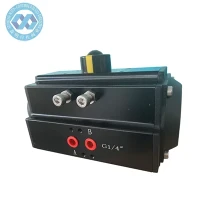
A few years ago, a customer from the chemical industry contacted us after experiencing repeated actuator replacement issues. The original plan seemed reasonable: install stainless steel pneumatic actuators throughout the facility and eliminate corrosion concerns once and for all.
But when we visited the site, the reality was more complicated.
Some valves were installed outdoors near chemical storage tanks. Others were located inside a clean utility building. A few actuators were exposed to daily washdown procedures, while others operated in relatively mild conditions.
The customer had spent a significant budget upgrading to stainless steel actuators, yet several operational challenges remained because the selection process focused on material alone rather than the overall application.
That experience reinforced something we often tell customers at WUXI XINMING AUTO-CONTROL VALVES INDUSTRY CO., LTD.:
Buying a stainless steel pneumatic actuator is not just about choosing stainless steel. It's about choosing the right actuator for the real-world conditions it will face every day.
Before making your next purchasing decision, here are ten key factors worth evaluating.
1. Understand the Actual Operating Environment
One of the first questions we ask customers is simple:
"Where will the actuator actually be installed?"
Many buyers immediately think about corrosion, but the environment can involve much more than that.
During one project review, we found that half of the actuators specified as stainless steel would be installed inside a temperature-controlled production hall. There was no chemical exposure, no salt spray, and very little moisture.
In those locations, the customer could have used aluminum actuators without sacrificing reliability.
Understanding the real environment helps avoid unnecessary spending while ensuring adequate protection where it is genuinely needed.
2. Evaluate Corrosion Risks Carefully
Not all corrosive environments are the same.
Common threats include:
- Salt-laden coastal air
- Chemical vapors
- High humidity
- Cleaning chemicals
- Industrial pollutants
I remember walking through a coastal wastewater treatment facility where even galvanized cable trays showed visible signs of corrosion after only a few years of service.
In that situation, stainless steel pneumatic actuators were clearly the right choice.
The more aggressive the environment, the more valuable corrosion-resistant materials become.
3. Verify the Stainless Steel Grade
One mistake we occasionally see is assuming all stainless steel offers identical performance.
It doesn't.
The difference between 304 stainless steel and 316 stainless steel can be significant in certain applications.
For example:
304 stainless steel performs well in many industrial environments.
316 stainless steel offers improved resistance to chlorides and salt exposure.
For coastal or marine applications, selecting the correct grade can dramatically extend equipment life.
Always confirm the actual material specification before placing an order.
4. Check Valve Torque Requirements
This sounds obvious, yet it remains one of the most common causes of actuator problems.
Several years ago, we assisted a customer whose valves operated perfectly during commissioning but struggled several months later.
The issue wasn't actuator quality.
The valves required more torque under actual process conditions than originally estimated.
A properly selected actuator should include sufficient torque margin to account for:
- Valve wear
- Process pressure changes
- Seal friction
- Long-term operating conditions
Never size an actuator using only theoretical values.
5. Consider the Type of Valve Being Automated
Different valves behave differently.
A ball valve, butterfly valve, and plug valve may all require pneumatic automation, but their torque curves can vary significantly.
We've seen projects where engineers selected actuators based only on valve size rather than valve behavior.
The result was inconsistent performance and unnecessary troubleshooting.
Understanding valve characteristics is just as important as understanding actuator specifications.
6. Think About Maintenance Accessibility
One lesson from field experience is that maintenance teams often view equipment differently than purchasing departments.
A few years ago, we visited a facility where several automated valves were mounted on elevated pipe racks.
Reaching the actuators required scaffolding and multiple technicians.
In situations like this, reliability becomes even more important because every maintenance intervention carries additional labor costs.
Before purchasing, consider how easily the actuator can be inspected, serviced, or replaced.
7. Evaluate Air Supply Quality
Many actuator failures have nothing to do with the actuator itself.
Contaminated compressed air can cause:
- Internal corrosion
- Seal degradation
- Reduced performance
- Shortened service life
One customer experienced repeated actuator issues before discovering excessive moisture in the compressed air system.
Once the air treatment equipment was upgraded, the actuator problems largely disappeared.
A high-quality actuator still depends on a high-quality air supply.
8. Understand Operating Frequency
How often will the actuator cycle?
This question matters more than many people realize.
An actuator that operates twice a week faces very different demands than one cycling hundreds of times per day.
High-cycle applications may require:
- Enhanced sealing systems
- More durable internal components
- Specific maintenance schedules
Understanding operating frequency helps ensure long-term reliability.
9. Consider Industry-Specific Requirements
Some industries impose additional demands beyond standard industrial operation.
For example:
- Food processing facilities often require frequent washdowns.
- Pharmaceutical plants demand strict hygiene standards.
- Marine applications require enhanced corrosion resistance.
- Chemical facilities may involve aggressive media exposure.
One food-processing customer specifically selected stainless steel pneumatic actuators because daily sanitation procedures exposed equipment to cleaning chemicals and high-pressure water.
The application itself justified the material choice.
10. Look Beyond the Purchase Price
Perhaps the most important factor is total cost of ownership.
Many buyers focus on the initial purchase price.
Experienced plant managers often look at:
- Expected service life
- Maintenance requirements
- Downtime costs
- Spare parts availability
- Replacement frequency
The cheapest actuator today can become the most expensive option over the next five years if reliability problems lead to repeated maintenance interventions.
A Question We Often Hear
One question comes up frequently:
"Should we just choose stainless steel for everything?"
Technically, you can.
But in many projects, that approach increases costs without delivering meaningful benefits.
The best solution is not necessarily the most expensive material.
It is the actuator that best matches the environment, operating conditions, and maintenance expectations of the application.
Final Thoughts
Choosing a stainless steel pneumatic actuator involves much more than selecting a corrosion-resistant housing.
Successful projects consider operating environment, valve requirements, air quality, maintenance access, operating frequency, and long-term lifecycle costs.
At WUXI XINMING AUTO-CONTROL VALVES INDUSTRY CO., LTD., we've learned through years of supporting valve automation projects that careful planning before purchase is often the best way to avoid costly problems later.
The right actuator is not simply the one with the highest specification.
It is the one that continues operating reliably long after the installation team has left the site.