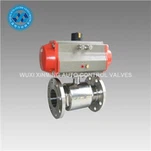
A ball valve is well - suited for high - pressure applications for several reasons.
Firstly, its design features a spherical ball with a hole through it. When the valve is closed, the ball provides a solid barrier against the high - pressure fluid. The ball is precisely machined to fit snugly within the valve body, minimizing the potential for leaks even under high - pressure conditions. The contact area between the ball and the valve seats is well - defined, which helps in withstanding the force exerted by the high - pressure fluid.
Secondly, the materials used in the construction of ball valves for high - pressure applications are carefully selected. The valve body and ball are often made of high - strength alloys such as stainless steel or carbon steel. These materials have excellent mechanical properties to endure the high - pressure forces without deformation. The valve seats are also made of durable materials like PTFE (polytetrafluoroethylene) or other high - performance polymers that can maintain a tight seal under pressure.
Moreover, the simple rotational operation of a ball valve is an advantage. The torque required to open or close the valve can be precisely controlled. This allows for smooth operation even when there is a significant pressure differential across the valve. The stem that rotates the ball is designed to handle the forces involved, ensuring reliable and safe operation in high - pressure systems such as in oil and gas pipelines or high - pressure steam lines.
If you want to know about wholesalers near me, please visit the following www.xmvalveactuator.com