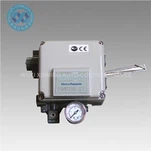
The double-acting scotch yoke pneumatic actuator is a device commonly used in industrial applications to control the movement of valves, dampers, or other mechanical components. Its working principle involves converting the linear motion of compressed air into rotary motion.
The actuator consists of a piston, a yoke, and a connecting rod. When compressed air is supplied to one side of the piston, it pushes the piston in one direction, causing the yoke to rotate. This is referred to as the "power stroke." During this stroke, the actuator generates a torque that can be used to open or close a valve, for example.
Once the piston reaches the end of the power stroke, the compressed air is redirected to the other side of the piston, causing it to move in the opposite direction. This is known as the "return stroke." During this stroke, the yoke rotates in the opposite direction, providing the necessary torque to complete the opening or closing action.
The scotch yoke mechanism plays a crucial role in converting the linear motion of the piston into rotary motion. It consists of a slotted yoke that engages with a pin on the piston rod. As the piston moves back and forth, the yoke's slot causes a reciprocating motion, which is then transformed into a rotary motion at the output shaft.
The double-acting scotch yoke pneumatic actuator offers a reliable and efficient way to control the movement of various mechanical components using compressed air. Its simple design and robust construction make it suitable for a wide range of industrial applications.