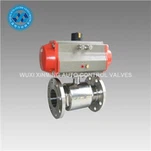
What is a pneumatic butterfly valve? Pneumatic butterfly valve installation requirements
Pneumatic butterfly valve is composed of pneumatic actuator and butterfly valve. The butterfly valve is a pneumatic valve that uses a circular butterfly plate that rolls with the valve stem to achieve opening and closing. It is mainly used as a cut-off valve. It can also be planned to have the function of regulating or segment valve and regulating. Now the butterfly valve is at low pressure and large The use of medium-diameter pipes is increasing. Butterfly valve classification: stainless steel butterfly valve, hard seal butterfly valve, soft seal butterfly valve, carbon steel butterfly valve. The main advantages of butterfly valves are simple structure, small size, light weight, and low cost. This feature of butterfly valves is particularly remarkable. It is installed in a dark tunnel at high altitude. It is convenient to control and operate through a two-position five-way solenoid valve, and it can also adjust the flow of media.
The butterfly valve, also known as the flap valve, is a simple-structured conditioning valve. The butterfly valve that can be used to switch low-pressure pipeline media refers to the closing part (disc or butterfly plate) as a disc, which rotates around the valve shaft to achieve opening and closing. A kind of valve. Valves can be used to control the flow of various types of fluids such as air, water, steam, various corrosive media, mud, oil, liquid metal and radioactive media. The primary effect of blocking and throttling on the pipeline. The butterfly valve opening and closing part is a disc-shaped butterfly plate, which rotates around its own axis in the valve body to achieve the purpose of opening and closing or conditioning.
Pneumatic butterfly valve device requirements:
1. Before the installation, check that there are no missing parts of the butterfly valve, the type is correct, check that there is no debris in the valve body, and there is no blockage in the solenoid valve and muffler. 2. Put the valve and the cylinder in a closed condition.
3. Install the cylinder on the valve, (the direction of the device is parallel or straight to the valve body), and then check whether the screw holes are aligned, there will not be too much error. If there is a little error, just roll the cylinder body a little. , And then tighten the screws.
4. After the installation is completed, debug the butterfly valve (the air supply pressure is 0.4~0.6MPa under normal conditions), and the solenoid valve must be manually opened and closed during the debugging operation (manual operation after the solenoid valve coil is de-energized can only be useful), and investigate The opening and closing of the butterfly valve. If the valve is found to be a little difficult at the beginning of the opening and closing process during the debugging operation, and then it is normal, you need to reduce the cylinder stroke (the stroke adjustment screws at both ends of the cylinder should be adjusted inward at the same time, and the valve should be operated to the open position during adjustment. Then turn off the air source and adjust it again) until the valve opens and closes smoothly and is closed without leakage.