

As a seasoned supplier of WCB Butterfly Valves, I've witnessed firsthand the importance of mastering the opening and closing control of these valves. In various industrial applications, the precise operation of WCB Butterfly Valves can significantly impact system performance, safety, and efficiency. In this blog, I'll share some in - depth knowledge and practical tips on how to control the opening and closing of a WCB Butterfly Valve.
Understanding the Basics of WCB Butterfly Valves
Before delving into the control methods, it's essential to understand what a WCB Butterfly Valve is. WCB is a common material for valve bodies, known for its good strength and corrosion - resistance properties. A butterfly valve consists of a disc mounted on a rotating shaft. When the valve is open, the disc is parallel to the flow direction, allowing fluid or gas to pass through with minimal obstruction. When closed, the disc is perpendicular to the flow, blocking the passage.
Manual Control
Manual control is the most straightforward way to operate a WCB Butterfly Valve. It usually involves a handwheel or a lever.
- Handwheel Operation: A handwheel is attached to the valve stem. By turning the handwheel clockwise or counter - clockwise, the valve disc rotates, either opening or closing the valve. This method is simple and cost - effective, suitable for small - scale applications or where the operating frequency is low. For example, in a small water treatment plant, manual handwheel - operated WCB Butterfly Valves can be used to control the flow of water in some auxiliary pipelines.
- Lever Operation: Levers provide a quick - acting solution. A short - throw lever can be used to open or close the valve with a simple 90 - degree movement. This is often used in applications where rapid on - off control is required, such as in emergency shut - off systems.
Electric Actuation
Electric actuators are widely used for controlling WCB Butterfly Valves, especially in large - scale industrial applications.
- Working Principle: An electric actuator consists of an electric motor, a gearbox, and a control unit. When an electrical signal is sent to the actuator, the motor rotates, and through the gearbox, the rotational motion is transferred to the valve stem, causing the valve disc to open or close.
- Advantages: Electric actuators offer precise control. They can be programmed to open or close the valve at specific angles, which is useful for applications where throttling is required. For instance, in a chemical processing plant, electric - actuated WCB Butterfly Valves can be used to precisely control the flow rate of different chemicals. Additionally, they can be integrated into automation systems, allowing for remote operation and monitoring.
- Limitations: Electric actuators are relatively expensive compared to manual control methods. They also require a reliable power supply, and in case of power failure, alternative control methods may be needed.
Pneumatic Actuation
Pneumatic actuation is another popular choice for controlling WCB Butterfly Valves.
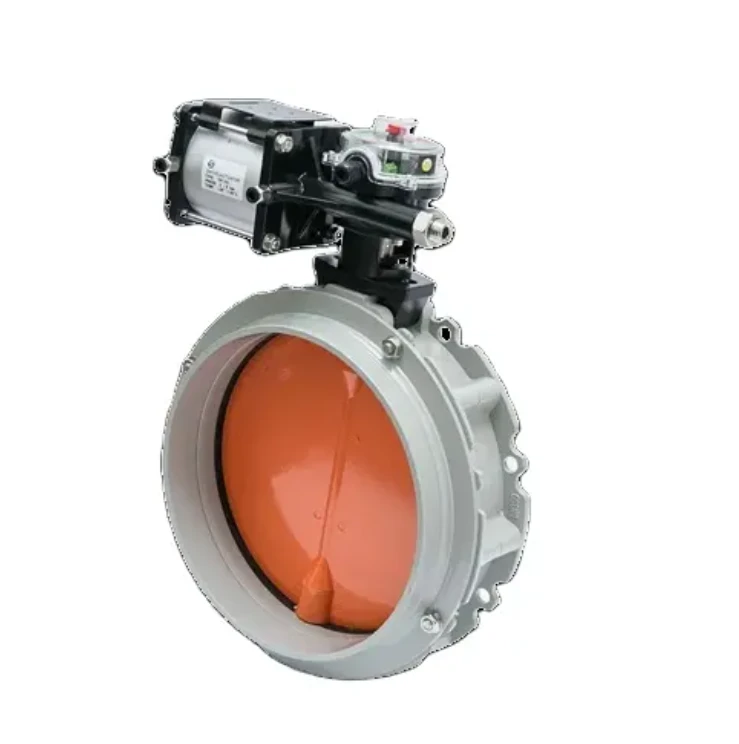
- How it Works: A pneumatic actuator uses compressed air to generate the force needed to open or close the valve. The actuator typically consists of a piston or a diaphragm. When compressed air is supplied to one side of the piston or diaphragm, it moves, and this movement is transferred to the valve stem.
- Benefits: Pneumatic actuators are fast - acting, making them suitable for applications where quick response times are crucial, such as in some high - speed fluid control systems. They are also explosion - proof, which is essential in hazardous environments like oil refineries. You can explore our Factory - direct Pneumatic Double Eccentric Flange Butterfly Valve for more details on pneumatic - actuated butterfly valves.
- Drawbacks: Pneumatic systems require a compressed air source, which adds to the complexity and cost of the installation. Also, the performance of pneumatic actuators can be affected by air pressure fluctuations.
Hydraulic Actuation
Hydraulic actuation is used in applications where high - torque operation is required.
- Principle: Hydraulic actuators use hydraulic fluid under pressure to move a piston or a cylinder. The hydraulic force is transferred to the valve stem, resulting in the opening or closing of the valve.
- Applications: This type of actuation is commonly found in large - diameter WCB Butterfly Valves used in power plants or large - scale water distribution systems. For example, in a hydroelectric power plant, hydraulic - actuated WCB Butterfly Valves are used to control the flow of water in the penstocks.
- Disadvantages: Hydraulic systems are complex and require regular maintenance. They also have a higher risk of fluid leakage, which can be a concern in some applications.
Control Strategies
- On - Off Control: This is the simplest control strategy, where the valve is either fully open or fully closed. It is suitable for applications where only two states are needed, such as in a basic water supply system where the valve is used to start or stop the flow of water.
- Proportional Control: In proportional control, the valve opening is proportional to the input signal. For example, if the input signal is 50%, the valve will open to 50% of its maximum capacity. This is useful for applications where precise flow control is required, such as in a heating, ventilation, and air - conditioning (HVAC) system.
- Modulating Control: Modulating control is a more advanced form of proportional control. The valve can continuously adjust its opening based on the changing process conditions. For instance, in a chemical reactor, a modulating - controlled WCB Butterfly Valve can adjust the flow of reactants to maintain a stable reaction environment.
Safety Considerations
- Over - travel Protection: When controlling the opening and closing of a WCB Butterfly Valve, over - travel protection is crucial. This prevents the valve disc from being forced beyond its normal opening or closing position, which can damage the valve and the actuator.
- Emergency Shutdown: In case of an emergency, such as a fire or a leak, the valve should be able to be closed quickly. All actuation systems should have an emergency shutdown feature, and manual override options should be available in case the automatic control system fails.
Maintenance and Monitoring
- Regular Inspections: Regular inspections of the valve and the actuation system are necessary to ensure proper operation. This includes checking for leaks, wear and tear of components, and the accuracy of the control system.
- Monitoring Systems: Installing monitoring systems can help detect any potential problems early. For example, sensors can be used to monitor the valve position, pressure, and temperature. Any abnormal readings can trigger an alarm, allowing for timely maintenance.
Conclusion
Controlling the opening and closing of a WCB Butterfly Valve is a multi - faceted task that requires a good understanding of the valve's operation, different actuation methods, control strategies, and safety considerations. As a WCB Butterfly Valve supplier, we offer a wide range of valves with various actuation options to meet different industrial needs. Whether you need a Damper Butterfly Valve for ventilation systems or a Wafer Hygienic Grade Actuator Pneumatic Butterfly Valve for food and beverage applications, we have the right solution for you.

If you're interested in our products or need more information on WCB Butterfly Valve control, feel free to contact us for procurement and further discussions. We're committed to providing high - quality products and professional technical support to help you achieve optimal valve control in your applications.
References
- Valves Handbook, McGraw - Hill
- Industrial Valve Technology, Wiley - Interscience




