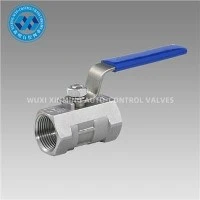
As a supplier of thin ball valves, I often encounter inquiries from customers about the maximum flow rate that these valves can handle. This is a crucial question, as the flow rate directly impacts the efficiency and performance of various industrial systems. In this blog post, I will delve into the factors that determine the maximum flow rate of a thin ball valve and provide some insights to help you make informed decisions.
Understanding Thin Ball Valves
Before we discuss the maximum flow rate, let's briefly understand what thin ball valves are. Thin ball valves are a type of quarter - turn valve that uses a hollow, perforated, and pivoting ball to control the flow of a liquid or gas. They are known for their compact design, quick operation, and reliable sealing performance. These valves are widely used in industries such as oil and gas, chemical processing, water treatment, and HVAC systems.
Factors Affecting the Maximum Flow Rate
The maximum flow rate that a thin ball valve can handle is influenced by several factors:
Valve Size
The size of the valve is one of the most significant factors affecting the flow rate. Larger valves generally have a higher maximum flow rate because they offer a larger cross - sectional area for the fluid to pass through. For example, a 2 - inch thin ball valve will typically have a higher flow rate than a 1 - inch valve. When selecting a valve, it is essential to choose the appropriate size based on the required flow rate of your system.
Valve Design
The design of the thin ball valve also plays a crucial role in determining the flow rate. Some valves are designed with a full - port or full - bore configuration, which means that the opening in the ball is the same size as the pipe. This design minimizes flow restrictions and allows for a higher flow rate. On the other hand, reduced - port valves have a smaller opening in the ball, which can limit the flow rate.
Fluid Properties
The properties of the fluid being transported, such as viscosity, density, and temperature, can significantly affect the flow rate. Viscous fluids, like oil, flow more slowly than less viscous fluids, such as water. High - density fluids may also require more energy to move through the valve, which can reduce the flow rate. Additionally, temperature can affect the viscosity and density of the fluid, further influencing the flow characteristics.
Pressure Drop
Pressure drop is the difference in pressure between the inlet and outlet of the valve. A higher pressure drop across the valve can reduce the flow rate. The pressure drop is affected by factors such as valve design, flow velocity, and fluid properties. When designing a system, it is important to consider the allowable pressure drop to ensure that the valve can achieve the desired flow rate.
Calculating the Maximum Flow Rate
To determine the maximum flow rate of a thin ball valve, engineers often use the flow coefficient (Cv). The flow coefficient is a measure of the valve's ability to pass a fluid. It is defined as the number of US gallons per minute (GPM) of water at 60°F that will flow through the valve with a pressure drop of 1 psi across the valve.


The formula for calculating the flow rate (Q) based on the flow coefficient (Cv) is:
[Q = Cv\sqrt{\frac{\Delta P}{SG}}]
where:
- Q is the flow rate in GPM
- Cv is the flow coefficient of the valve
- (\Delta P) is the pressure drop across the valve in psi
- SG is the specific gravity of the fluid
Most valve manufacturers provide the Cv values for their valves in their product catalogs. By using this formula and the appropriate Cv value, you can estimate the maximum flow rate of a thin ball valve for a given set of operating conditions.
Real - World Applications
Let's consider some real - world applications to understand the importance of the maximum flow rate of thin ball valves.
In the oil and gas industry, thin ball valves are used to control the flow of crude oil, natural gas, and refined products. In a pipeline system, a high - flow - rate valve is required to ensure efficient transportation of large volumes of fluids over long distances. A valve with a low maximum flow rate can cause bottlenecks and reduce the overall productivity of the system.
In water treatment plants, thin ball valves are used to regulate the flow of water during various treatment processes, such as filtration and disinfection. A valve with an appropriate maximum flow rate is essential to maintain the proper flow of water through the treatment system and ensure the quality of the treated water.
Our Product Offerings
As a supplier of thin ball valves, we offer a wide range of products to meet different flow rate requirements. Our Thread Ball Valve is designed for applications where a reliable and compact valve is needed. It is available in various sizes and configurations to provide a suitable flow rate for different systems.
We also offer 180 Degree Pneumatic Actuator 3 Way Ball Valve, 3 Way Ball Valve With Pneumatic Actuator, which is ideal for applications that require precise control of fluid flow. The pneumatic actuator allows for quick and accurate operation, making it suitable for high - flow - rate systems.
For applications in corrosive environments, our Pneumatic Stainless Steel 3 Way Ball Valve is a great choice. The stainless - steel construction provides excellent resistance to corrosion, while the pneumatic actuator ensures efficient operation and a high maximum flow rate.
Conclusion
The maximum flow rate of a thin ball valve is a critical parameter that depends on several factors, including valve size, design, fluid properties, and pressure drop. By understanding these factors and using the appropriate calculation methods, you can select the right valve for your application.
If you are looking for a thin ball valve with a specific maximum flow rate, we are here to help. Our team of experts can assist you in choosing the most suitable valve for your system. Whether you need a valve for a small - scale industrial application or a large - scale pipeline project, we have the products and expertise to meet your needs. Contact us today to start a discussion about your requirements and explore how our thin ball valves can enhance the performance of your system.
References
- Crane Co., "Flow of Fluids Through Valves, Fittings, and Pipe," Technical Paper No. 410.
- American National Standards Institute (ANSI), "ANSI/ISA - 75.01.01 - 2007, Flow Equations for Sizing Control Valves."
- Valve Manufacturers Association (VMA), "Valve Handbook," various editions.