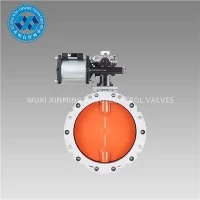
The angle travel pneumatic actuator is a device used to control the movement of valves in industrial processes. Its structure is designed to ensure reliable and efficient operation.
At the heart of the actuator is a piston that moves back and forth inside a cylinder. The piston is powered by compressed air that enters the actuator through a pneumatic port. The air pushes the piston in either direction, which in turn rotates the valve stem.
The piston is connected to a rack and pinion mechanism, which translates the linear motion of the piston into rotary motion of the valve stem. This mechanism ensures that the valve can be opened and closed smoothly and accurately.
The actuator also has a series of limit switches that control the position of the valve. These switches provide feedback to the control system, which can use them to determine the current state of the valve and adjust it as necessary.
One of the key advantages of the angle travel pneumatic actuator is its simplicity. There are relatively few parts involved in its operation, which makes it easy to install and maintain. It is also highly reliable, since there are no complex electronics or moving parts to worry about.
The angle travel pneumatic actuator is an essential component of many industrial processes. Its robust and reliable design ensures that valves can be controlled with precision and consistency, helping to maintain the safety and efficiency of a wide range of applications.