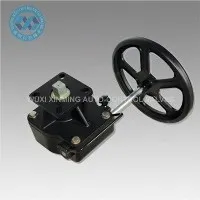
Pneumatic actuators are actuators that use air pressure to drive open, close or adjust valves, and are generally called pneumatic heads. Zhejiang Shuangzhong Automatic Control Valve Co., Ltd. has various technical requirements for pneumatic heads, and the characteristics of pneumatic actuators are compact double-piston gears, rack-type structure, accurate meshing, high efficiency, and constant output torque. When the compressed air enters the pneumatic actuator from the A nozzle, the gas pushes the double piston to move linearly to both ends (the cylinder head end), the rack on the piston drives the gear on the rotating shaft to roll 90 degrees counterclockwise, and the valve is opened. At this moment, the gas at both ends of the pneumatic actuator valve is discharged with the B nozzle. On the contrary, when the compressed air enters the two ends of the pneumatic actuator from the nozzle B, the gas pushes the double plug to move linearly toward the center, the rack on the piston drives the gear on the rotating shaft to roll 90 degrees clockwise, and the valve is closed. At this moment, the gas in the center of the pneumatic actuator is discharged with the A nozzle. On request, pneumatic actuators can be installed with a transmission principle opposite to that of the standard type.
Actuator is an indispensable structure in the process of industrial production automation. It is used frequently and is simply broken due to high temperature, high pressure and serious social and environmental problems, resulting in the need for repairs. The power of the actuator includes electric, pneumatic and hydraulic, but the fault and protection management methods of the pneumatic actuator system are mainly introduced here. The analysis results are as follows
Pneumatic actuator failures include blockages, leaks, and burnt control coils. Here, we will briefly analyze the problems in the repair method based on these three basic conditions.
Pneumatic actuator is stuck. Take the actuator apart, check for sticking, dissect and reassemble from scratch.
Check whether the pneumatic actuator is leaking, the valve stem is leaking, and check whether the sealing sleeve is damaged. If it is damaged, it needs to be replaced in time. Damaged seals cause leakage, check the piston or check for impurities, piston rings and smooth parts can be replaced. There is also the problem of the aging and degeneration of the coil, so you can use a multimeter to judge after power-on.