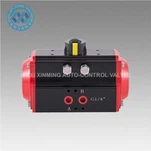
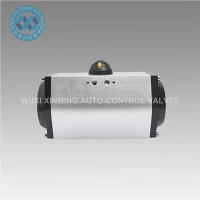
Pneumatic Actuators are categorized based on the motion they produce, with linear and rotational types being the most common. Each type has unique strengths that suit specific industrial needs.
Linear Pneumatic Actuators
1.Piston Cylinders
Piston cylinders are the most widely used linear type. They feature a piston moving inside a cylinder, driven by compressed air to generate straight-line motion. Their advantage lies in high force output, making them ideal for tasks like clamping workpieces or lifting heavy components. They also have a compact design, fitting easily into tight spaces in automation setups.
2.Diaphragm Actuators
Diaphragm actuators use a flexible diaphragm to convert air pressure into linear movement. They excel in applications requiring gentle force, such as handling fragile parts or adjusting valves with precision. Their sealed structure prevents air leakage and contamination, making them suitable for clean environments like food processing plants.
Rotational Pneumatic Actuators
1.Rack-and-Pinion Actuators
Rack-and-Pinion Actuators convert linear motion of a piston into rotational motion via a rack and pinion mechanism. They offer quick rotation speeds, enabling fast opening or closing of valves in pipelines. Their simple structure ensures reliable performance with minimal maintenance, a key advantage for continuous industrial operations.
2.Vane Actuators
Vane Actuators use a rotating vane inside a chamber; compressed air pushes the vane to create rotation. They provide smooth, consistent torque output, which is crucial for tasks like turning conveyor belts or adjusting mechanical arms. They also have a small footprint, saving space in crowded automation systems while delivering steady performance.
If you're interested in learning more about pneumatic actuators, please feel free to contact us! We have extensive industry experience and a professional engineering team, and we sincerely invite you to work together for success!