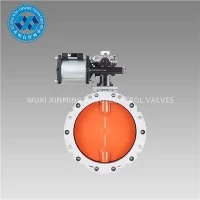
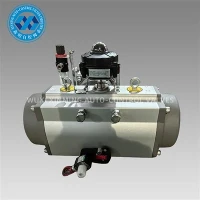
At WUXI XINMING AUTO-CONTROL VALVES INDUSTRY CO., LTD., our engineering team reviews dozens of actuator sizing requests every week. The most common mistake we see in the industry? Sizing a pneumatic rack and pinion actuator based purely on the valve's "running torque" or simply guessing based on the pipe diameter.
We've seen undersized actuators fail to fully seal a ball valve during an emergency shutdown, and we've seen oversized ones literally bend valve stems from excessive mechanical impact. Sizing isn't just about picking a model from a catalog; it's about understanding the real-world physics of your pipeline. Here is our field-tested approach to getting it right.
1. Hunt for the Breakaway Torque, Not Just Running Torque
When a ball or butterfly valve has been sitting in one position for weeks or months, the seat material slightly deforms around the disc or ball. The force required to unseat it-the breakaway torque-is often 30% to 50% higher than the torque needed to keep it moving (running torque).
Real-world scene: Last year, a client in the pulp and paper industry sized their actuators for 8-inch butterfly valves based on clean water data. But their actual medium was a viscous slurry. The valves jammed halfway through the stroke during commissioning. We recalculated using the breakaway torque for high-viscosity fluids and upgraded the actuator size. Always ask your valve manufacturer for the maximum breakaway torque under your specific operating conditions.
2. Apply the "Golden Rule" of Safety Margins
At Xinming, we never recommend a strict 1:1 match between actuator output and valve torque. We apply a standard 20% to 30% safety factor. Why? Because pipeline pressure fluctuations, minor debris in the line, or slight drops in plant air pressure can instantly eat up your margin. If your valve requires 100 Nm to break away, you need an actuator that delivers at least 120 Nm to 130 Nm at your minimum available air pressure.
3. Verify the Actual Plant Air Pressure
This is where many projects stumble. The actuator nameplate might be rated for 6 bar (87 psi), but by the time compressed air travels through hundreds of meters of piping, filters, and regulators, the pressure at the valve inlet might only be 4.5 bar. Since a rack and pinion actuator's torque output drops linearly with air pressure, sizing based on 6 bar when you only have 4.5 bar will result in a stalled valve. Always size based on the lowest guaranteed air pressure at the site.
4. Account for the Medium and Temperature
A ball valve handling clean air behaves very differently from one handling abrasive mining slurry or high-temperature steam. High temperatures can degrade standard PTFE seats, increasing friction, while abrasive media can score the ball, drastically spiking the required torque. For a recent chemical plant project in the Middle East, the ambient temperature reached 50°C, and the pipeline fluid was at 120°C. We had to factor in the thermal expansion of the valve internals, which increased the seating torque significantly compared to standard room-temperature catalogs.
5. Double-Acting vs. Spring Return Sizing
If you are using a spring return (fail-safe) actuator, remember that the springs consume a significant portion of the actuator's internal volume and force. The "spring stroke" torque (usually the closing stroke) will be lower than the "air stroke" torque. You must ensure that the minimum torque output of the spring return actuator-at the very end of the spring stroke, where the springs are fully compressed-still exceeds your valve's breakaway torque plus the safety margin.
Get Your Sizing Right the First Time
Sizing a pneumatic rack and pinion actuator for ball and butterfly valves is a balancing act between safety, cost, and mechanical limits. At WUXI XINMING AUTO-CONTROL VALVES INDUSTRY CO., LTD., we don't just sell actuators; we engineer reliable valve automation.
Don't risk pipeline leaks, actuator burnout, or bent valve stems on guesswork. Send us your valve's torque data sheet, medium details, and site air pressure. Our team will provide a free, precise actuator sizing calculation and a customized recommendation to ensure your system operates flawlessly for years. Contact Xinming today to discuss your next valve automation project.