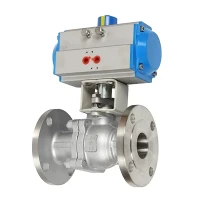
In valve automation projects, one of the decisions that often comes up during the engineering or procurement stage is choosing between a pneumatic rack and pinion actuator and a scotch yoke actuator.
On paper, both are designed to achieve the same goal - converting compressed air into rotary motion for quarter-turn valves. But in real industrial applications, especially where load conditions and operating environments vary, the differences between them become much more meaningful than many expect.
At WUXI XINMING AUTO-CONTROL VALVES INDUSTRY CO., LTD., we've seen both types used in water treatment plants, chemical facilities, and general process industries. The selection is rarely theoretical - it usually comes down to how the valve behaves in the real system.
Understanding the Basic Difference
Rack and Pinion Actuator
A rack and pinion actuator uses a very direct mechanism:
- Pneumatic pressure pushes pistons
- Pistons move linear racks
- Racks rotate a central pinion shaft
This design is compact, simple, and widely used for general quarter-turn valve automation.
Scotch Yoke Actuator
A scotch yoke actuator uses a different mechanical principle:
- A piston moves linearly
- A sliding yoke converts linear motion into rotation
- The output torque varies during the stroke
This design is known for producing high torque at the end positions, which is often critical for certain valve types.
What we observe in real engineering projects
In real commissioning work, the difference is not always obvious in drawings. It becomes clear during operation.
We once supported a water treatment project where butterfly valves were initially equipped with rack and pinion actuators. During testing, everything operated normally under stable air supply.
However, during peak load conditions - when pressure fluctuated and some valves had higher seating friction due to scale buildup - engineers noticed that a few valves required more torque at the final closing stage.
That is where scotch yoke actuators are often considered, because their torque output naturally increases at the end of stroke.
Torque behavior: the most important difference
This is usually the deciding factor.
Rack and Pinion
- More linear torque output
- Stable across the full 90° stroke
- Predictable performance
- Suitable for most standard valves
Scotch Yoke
- Higher torque at end positions
- Non-linear torque curve
- Better for break-to-open or tight shut-off conditions
- Strong performance in heavy-duty applications
In practice, engineers often say:
- Rack and pinion = smooth and stable
- Scotch yoke = strong at the critical moment
Size, weight, and installation differences
From an installation perspective, rack and pinion actuators are usually preferred when:
- Space is limited
- Weight reduction is important
- Standardized valve automation is required
Scotch yoke actuators tend to be:
- Heavier
- More robust
- Slightly larger for the same torque output
In retrofit projects, this difference sometimes becomes a real constraint, especially when existing piping supports are not designed for heavier actuator loads.
Where each type is typically used
Rack and Pinion Actuators are commonly used in:
- Water treatment systems
- HVAC applications
- General industrial automation
- Medium-duty valve control systems
- Standard ball and butterfly valve operations
Scotch Yoke Actuators are often used in:
- Oil and gas pipelines
- High-pressure valve systems
- Heavy-duty shut-off applications
- Valves requiring high breakaway torque
- Critical process safety systems
A practical selection perspective (not just theory)
In many discussions with customers, the question is not "which is better", but:
> "What happens when the valve becomes harder to operate over time?"
For example, valve torque does not stay constant. It can increase due to:
- Seat wear
- Scale or debris buildup
- Temperature changes
- Long-term operation
In these situations, scotch yoke actuators often provide a safety margin at the most critical point - the end of closing or opening stroke.
On the other hand, rack and pinion actuators perform very reliably in systems where operating conditions are stable and well controlled.
What we usually recommend at WUXI XINMING
At WUXI XINMING AUTO-CONTROL VALVES INDUSTRY CO., LTD., we rarely recommend actuator type in isolation.
Instead, we evaluate:
- Valve type
- Required torque curve, not just peak torque
- Air supply stability
- Operating frequency
- Installation space limitations
- Long-term maintenance expectations
In many water treatment and general industrial projects, rack and pinion actuators are still the most commonly selected solution because they offer a good balance between cost, stability, and ease of maintenance.
However, in higher-load or safety-critical applications, scotch yoke designs are often the more suitable choice.
Conclusion
Both rack and pinion and scotch yoke pneumatic actuators are mature and widely used technologies. The real difference is not in "which is better overall", but in which one matches your operating conditions more accurately.
If you need compact structure, stable torque, and general valve automation → Rack and Pinion Actuator
If you need higher torque at critical positions and heavy-duty performance → Scotch Yoke Actuator
In real engineering projects, the best choice is always the one that fits the valve behavior in the actual system - not just the specification sheet.