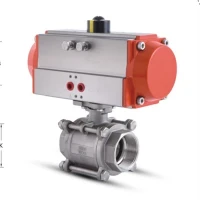
In industrial valve automation systems, one of the most common decisions engineers face is choosing between a spring return pneumatic actuator and a double acting pneumatic actuator.
At first glance, the two may look similar. Both are used to operate ball valves, butterfly valves, and other quarter-turn valves. However, the internal working principles and real-world behavior under failure conditions are very different.
Choosing the wrong type can lead to serious consequences in process safety, maintenance cost, and system reliability.
1. How the Two Actuators Work
Spring Return Pneumatic Actuator
A spring return actuator uses compressed air for movement in one direction and an internal spring pack for the return stroke.
When air is supplied:
The pistons move and rotate the pinion via rack-and-pinion mechanism
- The valve opens or closes
- Springs are compressed and store energy
When air is lost:
- The spring force automatically drives the actuator back
- The valve moves to a predefined safe position
This is called **fail-safe operation.
Double Acting Pneumatic Actuator
A double acting actuator uses compressed air for both opening and closing strokes.
- Air pressure opens the valve
- Air pressure also closes the valve
- No spring is involved
This means the actuator stops wherever it is when air is lost, unless an external system is added.
2. Key Difference: What Happens When Air Supply Fails?
This is the most important factor in real industrial applications.
Spring return actuator → automatically moves to safe position
Double acting actuator → stays in last position
In many industries, this single difference determines the entire selection.
For example, in a chemical dosing system we supported, the customer initially used double acting actuators. During a compressed air interruption, several valves remained partially open, causing unstable chemical flow.
After upgrading to **spring return pneumatic rotary actuators**, the system automatically shut the critical valves during air failure, stabilizing the process.
3. Performance Comparison
Spring Return Actuator – Key Advantages
- Fail-safe operation
- Suitable for emergency shutdown systems
- Preferred in hazardous environments
- Higher system reliability under air failure conditions
Double Acting Actuator – Key Advantages
- Higher efficiency for continuous cycling
- More compact design
- Lower initial cost
- Suitable where fail-safe is not required
4. Where Each Type Is Used
Spring Return Actuators Are Common In:
- Oil and gas pipelines
- Chemical processing plants
- Fire protection systems
- Water treatment facilities
- Pharmaceutical production lines
Double Acting Actuators Are Common In:
- General industrial automation
- Non-critical flow control systems
- High-frequency cycling applications
- Systems with backup air supply
5. How to Choose the Right One?
Instead of asking "which is better", engineers should ask:
✔ Do I need fail-safe operation?
If YES → Spring return actuator is required.
✔ Is air failure a safety risk?
If YES → Spring return actuator is strongly recommended.
✔ Is cost and cycling speed the priority?
If YES → Double acting actuator may be sufficient.
6. Engineering Insight from Real Projects
In actual valve automation projects, actuator selection is rarely based on price alone.
At WUXI XINMING AUTO-CONTROL VALVES INDUSTRY CO., LTD., we have seen many cases where customers initially chose double acting actuators to reduce cost. However, after commissioning, they realized that air supply instability or emergency shutdown requirements made the system unsafe.
In such cases, upgrading to **spring return pneumatic rotary actuators (rack and pinion type)*is often the final solution to ensure stable and fail-safe operation.
This is especially common in water treatment and chemical dosing systems, where valve position during failure is more important than normal operation efficiency.
7. Conclusion
So, which is better: spring return or double acting pneumatic actuators?
The answer depends entirely on the application:
If safety and fail-safe operation matter → Spring Return Actuator
If cost and continuous cycling are the priority → Double Acting Actuator
In modern industrial automation, engineers increasingly prefer spring return actuators for critical systems because they provide an additional layer of protection during unexpected air supply failures.
Understanding this difference is not just a technical choice-it is a system safety decision.