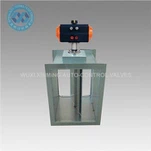
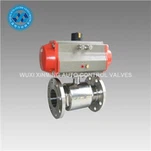
1. The working principle of the electric butterfly valve:
The working power supply of electric actuators usually includes AC220V, AC380V, etc. After the adjustment of electric actuator and valve stem are installed and adjusted; electric energy is used as the driving force to drive the valve plate of the butterfly valve to perform partial reversal movement from 0 to 90 to receive industrial The 4-20mA signal of the automatic control system can accurately control the opening and closing degree of the valve to achieve the adjustment and control of different required parameters such as flow, temperature, and pressure.
2. Working principle of pneumatic butterfly valve:
It is composed of the connection of the pneumatic actuator and the butterfly valve. The pneumatic butterfly valve enters the air actuator through compressed air and drives the actuator to rotate the circular butterfly valve by 90, which is used as a piping switch and flow adjustment. Pneumatic butterfly valve uses 0-90 degree opening and closing as its working principle. In other words, 0 degrees is a fully closed state, and 90 degrees is a fully open state. Install positionable equipment on the pneumatic actuator, and after inputting the corresponding signal, the butterfly valve plate can be adjusted arbitrarily from 0 degrees to 90 degrees. It can be used as a pneumatic butterfly valve. In addition, filter pressure reducing valves and solenoid valves can be added to better control the use of pneumatic butterfly valves.
Actuator comparison: Actuator is a device that receives control information through automated technical tools and controls the controlled object. According to the driving energy used, actuators are divided into three categories: pneumatic, electric, and hydraulic actuators. Electric actuators and pneumatic actuators are today's mainstream actuators. Our Guanliang Valve analyzes the comparison between electric actuators and pneumatic actuators.
We mainly conduct a comprehensive comparison from the aspects of initial cost, operation, performance, scale, action speed, corrosion prevention, operational safety, maintenance, and fail-safe after-sales service guarantee.
The main features of the pneumatic butterfly valve are that the pneumatic butterfly valve is small in size, light in weight, easy to disassemble and repair, and can be installed in any position. The connection between the butterfly plate and the rod adopts a pinless structure to overcome potential internal leakage points. The outer circumference adopts a spherical surface. The shape improves the sealing performance and prolongs the life of the valve.