Pneumatic butterfly valve installation analysis
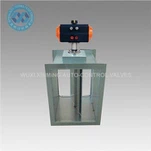
Pneumatic butterfly valve is composed of pneumatic actuator and butterfly valve. The pneumatic butterfly valve uses a circular butterfly plate that rolls with the valve mandarin for opening and closing. The pneumatic valve that realizes the activation action is mainly used as a cut-off valve. It can also be designed to have the function of regulating or segment valve and regulating. At present, the butterfly valve is in the low pressure The use of medium-diameter pipes is increasing.
The butterfly plate of the butterfly valve is installed in the diameter direction of the pipeline. In the cylindrical passage of the butterfly valve body, the disc-shaped butterfly plate rotates around the axis, and the rotation angle is between 0°-90°. When the rotation reaches 90°, the valve is in a fully open state. The butterfly valve is simple in structure, small in size, light in weight, and consists of only a few parts.
And it can be quickly opened and closed only by rotating 90°, and the operation is simple. At the same time, the valve has good fluid control characteristics. When the pneumatic butterfly valve is in the fully open position, the thickness of the butterfly plate is the only resistance when the medium flows through the valve body, so the pressure drop generated by the valve is small, so it has better flow control characteristics.
The butterfly valve has two sealing types: elastic seal and metal seal. Elastic sealing valve, the sealing ring can be inlaid on the valve body or attached to the periphery of the butterfly plate.
Valves with metal seals generally have a longer life than valves with elastic seals, but it is difficult to achieve a complete seal. Metal seals can adapt to higher operating temperatures, while elastic seals have the disadvantage of being limited by temperature.
If the butterfly valve is required to be used as a flow control, the first thing is to choose the size and type of the valve correctly. The structure principle of butterfly valve is especially suitable for making large-diameter valves. Butterfly valves are not only widely used in general industries such as petroleum, gas, chemical, and water treatment, but also used in cooling water systems in thermal power stations.
Commonly used butterfly valves include wafer type butterfly valves and flange type butterfly valves. Wafer type butterfly valve uses double-head bolts to connect the valve between two pipe flanges. Flange type butterfly valve has flanges on the valve, and bolts are used to connect the flanges at both ends of the valve to the pipe flanges.