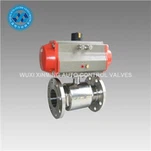
In the actual production process, it is very important to correctly select the pneumatic actuator of the pneumatic valve, because if the actuator is too large, the valve stem may be subjected to too much force, and if the actuator is too small, it cannot generate enough torque to fully operate the valve .
Generally speaking, the selection of pneumatic actuators needs to consider multiple factors, such as the use of the valve, use temperature, operating frequency, management and pressure difference, transmission medium (lubrication, dryness, mud, etc.). In the process of selecting a pneumatic actuator, the key points are as follows.
The operation panel has two electric devices with direct output without thrust:
1 thrust disc; the other is configured with a thrust disc, and the output torque is converted into output thrust through the valve stem nut in the thrust disc.
2. Working torque: Select the main parameters of the valve electric device, the output torque of the pneumatic actuator should be 1.2~1.5 times of the working torque of the large valve.
3. Stem diameter to multi-turn rising stem valve: If the larger stem diameter allowed by the electric device cannot pass through the valve stem of the valve, it cannot be assembled into an electric valve. Therefore, the inner diameter of the hollow output shaft of the electric device must be larger than the outer diameter of the stem of the rising stem valve. For some rotary valves and concealed stem valves in multi-turn valves, although the passage of the stem diameter is not considered, the diameter of the stem and the size of the keyway should also be fully considered when selecting, so that they can work normally after assembly.
Like other types of actuators, pneumatic actuators share many common characteristics. At the same time, they also have their own special functions and play an important role in many industries. It can be said that in these industries, the reputation of pneumatic actuators is indispensable. Compared with other types of actuators, pneumatic actuators have special functions, and it is because of these functional advantages that we choose it. So, what are the special functions of pneumatic actuators?
Functions of stainless steel pneumatic actuators: Stainless steel pneumatic actuators have both positive and negative effects. When the signal increases, the downward movement of the valve stem is called positive effect, and vice versa; the pneumatic actuator has a large movement speed, but as the load increases, the speed will slow down, which has a good regulation function. Stainless steel pneumatic actuators have many functions. They have a number of performance characteristics that outperform comparable drives. In addition to purchasing pneumatic ball valves, many buyers will also purchase pneumatic actuators by the way. The output force of the pneumatic actuator is related to the working pressure, with high reliability and stability. However, after the air supply is interrupted, the valve cannot be maintained. To maintain it, a holding valve must be added.
Of course, pneumatic actuators also have some disadvantages. For example, pneumatic actuators are not easy to realize segmented control and program control, which can be realized after improvement. Today's pneumatic actuators are easy to service and maintain. It only needs to do simple daily maintenance and has good adaptability to the environment.