

Hey there! As a supplier of AT Pneumatic Actuators, I often get asked if these actuators can be used in low - pressure applications. So, I thought I'd write this blog to share my thoughts and experiences on the matter.
First off, let's understand what an AT Pneumatic Actuator is. It's a device that uses compressed air to create motion. These actuators are commonly used in industrial settings to control valves, automate processes, and perform various mechanical tasks. They're known for their reliability, durability, and efficiency.
Now, the big question: Can they work in low - pressure applications? The short answer is yes, but it depends on a few factors.
Factors to Consider
1. Torque Requirements
In any application, the actuator needs to generate enough torque to perform the required task. In low - pressure applications, the available air pressure is limited, which means the actuator might not be able to generate as much torque as it would in a high - pressure environment.
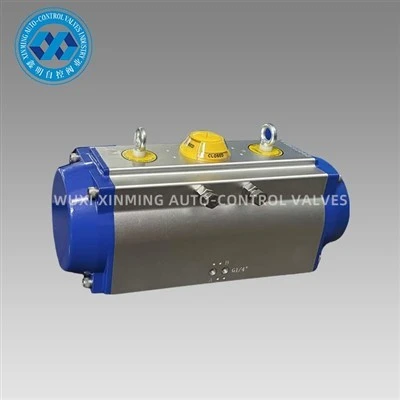

For example, if you're using the actuator to operate a large valve, a low - pressure system might not provide enough force to open or close the valve properly. However, if the valve is small and doesn't require much torque to operate, an AT Pneumatic Actuator can work just fine. You can check out our Quarter Turn Air Actuator For Ball/butterfly Valve Double Acting Pneumatic Rotary Actuator which is designed to handle different torque requirements and might be suitable for low - pressure valve operations.
2. Actuator Size and Design
The size and design of the actuator play a crucial role in its performance under low - pressure conditions. A larger actuator generally requires more air pressure to operate effectively. So, for low - pressure applications, a smaller - sized AT Pneumatic Actuator might be a better choice.
Some actuators are also designed specifically for low - pressure use. These actuators have features like larger piston areas or more efficient air distribution systems that allow them to generate sufficient force even with low air pressure. Our Pneumatic Actuator Without Cu Or Zn comes in different sizes and has a design that can be optimized for low - pressure applications.
3. Application Environment
The environment in which the actuator will be used is another important factor. Low - pressure applications might be more common in some industries than others. For instance, in the food and beverage industry, where hygiene and safety are top priorities, low - pressure pneumatic systems are often preferred.
In such environments, the actuator needs to be able to withstand the specific conditions, such as temperature, humidity, and the presence of certain chemicals. AT Pneumatic Actuators are made from high - quality materials that can resist corrosion and wear, making them suitable for a wide range of application environments, including low - pressure ones.
Advantages of Using AT Pneumatic Actuators in Low - Pressure Applications
1. Energy Efficiency
One of the biggest advantages of using AT Pneumatic Actuators in low - pressure applications is energy efficiency. Since the air pressure is low, less energy is required to compress the air. This can result in significant cost savings over time, especially for applications that run continuously.
2. Safety
Low - pressure pneumatic systems are generally safer than high - pressure ones. There's less risk of air leaks causing sudden and dangerous movements, and the components are less likely to fail due to high - pressure stress. AT Pneumatic Actuators are designed with safety in mind, and their use in low - pressure applications further enhances this aspect.
3. Compatibility
AT Pneumatic Actuators are highly compatible with other components in a low - pressure system. They can be easily integrated with valves, sensors, and other control devices, making them a versatile choice for various automation tasks. Our High - Performance Pneumatic Actuators For Demanding Automation Tasks are designed to work seamlessly with other system components, even in low - pressure setups.
Limitations and Challenges
1. Limited Speed and Force
As mentioned earlier, low - pressure applications can limit the speed and force of the actuator. If your application requires fast and powerful movements, a low - pressure AT Pneumatic Actuator might not be the best option. In such cases, you might need to consider using a high - pressure system or a different type of actuator.
2. Maintenance
While AT Pneumatic Actuators are generally low - maintenance, low - pressure systems might require more frequent checks for air leaks. Even a small leak can have a significant impact on the performance of the actuator in a low - pressure environment. Regular maintenance and inspection are essential to ensure the proper functioning of the actuator.
Conclusion
So, can an AT Pneumatic Actuator be used in low - pressure applications? The answer is a definite yes, but you need to carefully consider the torque requirements, actuator size and design, and the application environment. If these factors are in your favor, an AT Pneumatic Actuator can offer energy efficiency, safety, and compatibility benefits.
If you're thinking about using an AT Pneumatic Actuator in a low - pressure application, I'd be more than happy to help you find the right solution. Just reach out to us, and we can discuss your specific needs and requirements. Whether it's for a small - scale project or a large - scale industrial application, we have the expertise and products to meet your demands.
Let's work together to find the perfect AT Pneumatic Actuator for your low - pressure application. Contact us today to start the conversation!
References
- Pneumatic Actuator Handbook, Industry Standard Publication
- Technical Papers on Low - Pressure Pneumatic Systems, Academic Journals




