Hey there! As a supplier of manual handwheels, I often get asked all sorts of questions about our products. One question that popped up recently is, "What is the electrical conductivity of a manual handwheel?" Let's dig into this topic and find out what's what.
First off, let's understand what electrical conductivity is. Simply put, it's a measure of how well a material allows an electric current to pass through it. Materials can be conductors, which let electricity flow easily, insulators, which don't let electricity flow at all, or semiconductors, which are somewhere in between.
Now, when it comes to manual handwheels, the electrical conductivity depends a lot on the materials they're made of. Manual handwheels can be crafted from a variety of materials, each with its own unique electrical properties.
Common Materials and Their Conductivity
Metal Handwheels
Metals are well - known conductors of electricity. Many manual handwheels are made from metals like steel, aluminum, or brass.
Steel handwheels, for example, are strong and durable. Steel is an alloy that contains iron and carbon, along with other elements in smaller amounts. Iron is a good conductor of electricity, so steel handwheels have relatively high electrical conductivity. This means that if you were to apply an electrical current to a steel handwheel, the electrons would be able to move through it quite easily.
Aluminum is another popular choice for handwheels. It's lightweight and corrosion - resistant. Aluminum has excellent electrical conductivity as well. In fact, it's one of the most commonly used metals in electrical applications because it can conduct electricity efficiently while being relatively inexpensive.
Brass is an alloy of copper and zinc. Copper is an outstanding conductor, and brass inherits a good amount of that conductivity. Brass handwheels are often used in applications where both conductivity and corrosion resistance are required.
Plastic Handwheels
Plastics, on the other hand, are generally insulators. They have very low electrical conductivity because the electrons in plastics are tightly bound and don't move freely. If you have a plastic manual handwheel, it's not going to conduct electricity well. This can be an advantage in some situations, like when you want to prevent electrical shock or when you're using the handwheel in an environment where electrical interference needs to be minimized.
Composite Handwheels
Composite materials are made by combining two or more different materials. For example, a composite handwheel might have a plastic core with a metal outer layer. The electrical conductivity of a composite handwheel will depend on the proportion and arrangement of the conductive and non - conductive materials. If the metal layer is continuous and thick enough, the handwheel will have some degree of conductivity. But if the plastic core dominates, the overall conductivity will be low.

Why Does Electrical Conductivity Matter?
The electrical conductivity of a manual handwheel can be crucial in different applications.
In industrial settings, especially in electrical or electronic manufacturing, handwheels that conduct electricity can be used as part of electrical circuits. For example, in some control panels, a conductive handwheel might be used to adjust a variable resistor or to make an electrical connection when turned.
On the other hand, in environments where safety is a concern, non - conductive handwheels are preferred. In chemical plants, for instance, workers might be handling equipment that uses electricity. A non - conductive handwheel can prevent accidental electrical shocks, reducing the risk of injury. You can check out our High Quality Circular Hand Wheel Chemical Plant Emergency Cut - off Control which is designed with safety in mind.
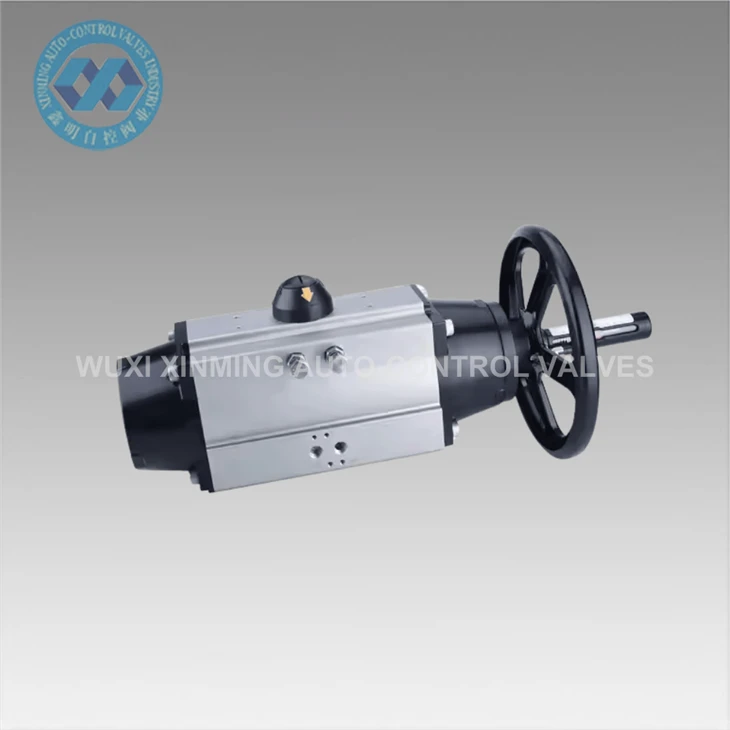
In pneumatic systems, the electrical conductivity of handwheels might not seem as important at first glance. However, in some cases, static electricity can build up. Conductive handwheels can help dissipate this static charge, preventing potential damage to sensitive components. Our High Efficiency Air Single And Double Acting Air Handwheel Pneumatic Actuator is an example of a product where the right conductivity properties can make a difference.
Measuring Electrical Conductivity
If you're curious about the exact electrical conductivity of a manual handwheel, it can be measured using a device called a conductivity meter. This device applies a known electrical current to the material and measures the resulting voltage. By using Ohm's law (V = IR, where V is voltage, I is current, and R is resistance), the conductivity can be calculated.
However, in most cases, as a user, you don't need to measure the conductivity yourself. The manufacturer should be able to provide you with information about the electrical properties of the handwheel based on the materials used.
Choosing the Right Handwheel Based on Conductivity
When you're in the market for a manual handwheel, you need to consider the electrical conductivity requirements of your application.
If you're working in an electrical or electronic environment where conductivity is needed, go for a metal handwheel. Steel, aluminum, or brass handwheels will serve you well.
If safety from electrical shock is your main concern, or if you're in an environment where electrical interference is an issue, a plastic or composite handwheel with low conductivity is the way to go.
We offer a wide range of manual handwheels to meet different needs. Our High Efficiency Air Single And Double Acting Air Handwheel Pneumatic Actuator is just one of the many products in our catalog.
Conclusion
In conclusion, the electrical conductivity of a manual handwheel depends on the materials it's made of. Metal handwheels are generally good conductors, while plastic handwheels are insulators. The conductivity can have a significant impact on the performance and safety of the handwheel in different applications.
If you're looking for a manual handwheel and have questions about electrical conductivity or any other aspect of our products, don't hesitate to reach out. We're here to help you find the perfect handwheel for your needs. Whether you need a conductive handwheel for an electrical application or a non - conductive one for safety reasons, we've got you covered. Start a conversation with us to discuss your requirements and let's find the best solution together.
References
- "Materials Science and Engineering: An Introduction" by William D. Callister Jr. and David G. Rethwisch
- Industrial Electrical Handbook for practical applications and material properties.