When it comes to industrial automation and control systems, pneumatic actuators are a cornerstone technology. As a trusted pneumatic actuator supplier, I'm often asked about the force output of these remarkable devices. Understanding the force output of a pneumatic actuator is crucial for ensuring that it can perform its intended function effectively and safely in a wide range of applications.
The Basics of Pneumatic Actuators
Before delving into the force output, let's briefly review what a pneumatic actuator is. A pneumatic actuator is a device that converts compressed air energy into mechanical motion. It typically consists of a cylinder, a piston, and valves. When compressed air is introduced into one side of the piston, it creates pressure, which causes the piston to move, generating linear or rotary motion depending on the actuator's design.
Pneumatic actuators are widely used in various industries, including manufacturing, automotive, food processing, and pharmaceuticals, due to their simplicity, reliability, and cost - effectiveness. They can be found in applications such as opening and closing valves, moving conveyor belts, and operating robotic arms.
Factors Affecting the Force Output of Pneumatic Actuators
The force output of a pneumatic actuator is determined by several key factors:
Air Pressure
The most significant factor affecting the force output is the air pressure applied to the actuator. According to Pascal's law, the force exerted on the piston of a pneumatic actuator is directly proportional to the pressure of the compressed air and the cross - sectional area of the piston. Mathematically, the formula for the force (F) in a linear - acting pneumatic actuator is F = P × A, where P is the air pressure and A is the cross - sectional area of the piston.
For example, if we have a pneumatic actuator with a piston diameter of 50 mm (which gives a cross - sectional area (A=\pi\times(\frac{50}{2})^2=\frac{\pi\times25^2}{1000^2}\ m^2\approx 0.00196\ m^2)) and the air pressure applied is 6 bar (600,000 Pa), the force output can be calculated as (F = 600000\times0.00196 = 1176\ N).
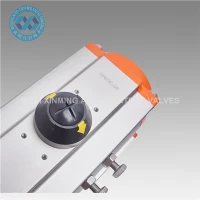
As a supplier, we offer pneumatic actuators that can operate at different pressure ranges. High - pressure applications may require actuators specifically designed to handle elevated pressures to ensure optimal force output and safety. You can find our Full Angle Range Adjustment 180 Degree Pneumatic Actuator, which is suitable for various pressure scenarios and can provide reliable force output for angle adjustment tasks.


Piston Area
As mentioned in the formula above, the cross - sectional area of the piston also plays a crucial role in determining the force output. A larger piston area will result in a greater force output for the same air pressure. Actuators with larger pistons are often used in applications that require high - force output, such as heavy - duty industrial machinery.
Some applications may have space constraints, which limit the size of the piston. In such cases, we can recommend smaller - sized actuators with optimized designs to achieve the necessary force output within the given space. Our Air Driven Actuator series offers a variety of piston sizes and configurations to meet different application requirements.
Friction and Efficiency
Friction within the actuator can reduce the effective force output. Friction can occur between the piston and the cylinder wall, in the seals, and in the moving parts of the actuator. To minimize friction, high - quality materials and precision manufacturing are essential.
Actuator efficiency also affects the force output. A less efficient actuator will waste some of the energy from the compressed air, resulting in a lower force output than expected. Our Reliable And Durable Pneumatic Actuators are designed with advanced engineering and high - quality components to minimize friction and maximize efficiency, ensuring that you get the most out of the available air pressure.
Calculating the Force Output for Different Types of Pneumatic Actuators
Linear Pneumatic Actuators
As described earlier, the force output of a linear pneumatic actuator is calculated using the formula (F = P\times A). The direction of the force is along the axis of the piston's movement. When selecting a linear actuator, it's important to consider not only the required force but also the stroke length, which is the distance the piston can travel.
Rotary Pneumatic Actuators
For rotary pneumatic actuators, the output is typically measured in terms of torque. Torque is the rotational force that causes an object to rotate. The torque output of a rotary pneumatic actuator depends on the air pressure, the effective radius of the actuator's rotating part, and the mechanical design of the actuator.
The formula for torque (T) is (T = F\times r), where F is the force acting perpendicular to the radius r. In a rotary pneumatic actuator, the force is generated by the pressure - driven movement of the internal components, and the radius is related to the design of the actuator's rotating mechanism.
Importance of Accurately Determining Force Output
Accurately determining the force output of a pneumatic actuator is essential for several reasons. Firstly, it ensures that the actuator can perform its intended task. For example, in a valve - opening application, if the force output of the actuator is too low, the valve may not open fully, leading to reduced flow or malfunction.
Secondly, it helps in selecting the right actuator for the application. Over - sizing the actuator can lead to increased costs, both in terms of the initial purchase price and the energy consumption required to operate the actuator. Under - sizing, on the other hand, can result in premature wear and failure of the actuator.
Applications and Force Output Requirements
Different applications have different force output requirements. In the automotive industry, pneumatic actuators are used in assembly lines for tasks such as tightening bolts. These applications typically require relatively high - force output to ensure proper fastening.
In the food and beverage industry, pneumatic actuators are used for tasks such as opening and closing packaging machinery. The force requirements in these applications are usually lower, but precision and reliability are crucial to ensure product quality and safety.
Our Role as a Pneumatic Actuator Supplier
As a pneumatic actuator supplier, we understand the importance of providing accurate force output information to our customers. We offer a comprehensive range of pneumatic actuators, each carefully designed and tested to meet specific force output requirements.
Our team of experts can assist you in selecting the right actuator for your application. We take into account factors such as the required force output, stroke length, operating environment, and budget to recommend the most suitable product.
If you are in the process of selecting a pneumatic actuator for your project, we encourage you to contact us for further discussion. We are committed to providing high - quality products and excellent customer service to help you achieve your automation goals. Whether you need a Full Angle Range Adjustment 180 Degree Pneumatic Actuator, an Air Driven Actuator, or a Reliable And Durable Pneumatic Actuators, our team is here to support you every step of the way.
References
- "Pneumatic Systems Handbook", by Peter Nachtwey
- "Industrial Automation: Principles and Applications", by Patrick W. Tretter