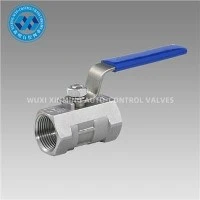
In the realm of fluid control systems, thread ball valves play a pivotal role. As a trusted thread ball valve supplier, I've witnessed firsthand the importance of understanding the relationship between valve opening and flow rate. This knowledge is not only crucial for engineers and technicians but also for end - users who rely on efficient fluid management in various applications.
Understanding Thread Ball Valves
Thread ball valves are a type of quarter - turn valve that uses a hollow, perforated, and pivoting ball to control the flow of liquid or gas. The ball has a hole (port) through it, and when the valve is fully open, the port aligns with the pipe, allowing unobstructed flow. When the valve is closed, the ball is rotated 90 degrees so that the port is perpendicular to the flow path, blocking the fluid.
These valves are highly popular due to their simple design, reliable performance, and low maintenance requirements. They are commonly used in a wide range of industries, including oil and gas, water treatment, chemical processing, and HVAC systems.
The Relationship between Valve Opening and Flow Rate
The relationship between the valve opening and the flow rate in a thread ball valve is complex and non - linear. At a fundamental level, the flow rate through a valve is determined by the pressure drop across the valve and the valve's flow coefficient (Cv). The flow coefficient is a measure of the valve's capacity to pass fluid and is affected by the valve's size, design, and the degree of opening.
When the thread ball valve is fully open, the flow path is at its maximum cross - sectional area, and the flow rate is primarily limited by the pipe's resistance and the pressure available in the system. In this state, the valve offers the least amount of resistance to the flow, and the flow rate is relatively high.
As the valve begins to close, the cross - sectional area of the flow path decreases. According to the principle of continuity (Q = A×v, where Q is the volumetric flow rate, A is the cross - sectional area, and v is the fluid velocity), for an incompressible fluid, a decrease in the cross - sectional area leads to an increase in the fluid velocity. However, this also causes an increase in the pressure drop across the valve.
The relationship between the valve opening (expressed as a percentage of the full - open position) and the flow rate is often represented by a flow characteristic curve. For a thread ball valve, the typical flow characteristic is quick - opening at the beginning. This means that a small change in the valve opening from the fully closed position results in a large increase in the flow rate. As the valve approaches the fully open position, the rate of increase in the flow rate slows down.
Mathematically, the flow rate (Q) through a valve can be calculated using the following formula:
[Q = C_v\sqrt{\frac{\Delta P}{G}}]
where (\Delta P) is the pressure drop across the valve and (G) is the specific gravity of the fluid. The flow coefficient (C_v) is a function of the valve opening. As the valve closes, (C_v) decreases, which in turn reduces the flow rate.
Factors Affecting the Relationship
Several factors can influence the relationship between valve opening and flow rate in a thread ball valve:
- Valve Design: Different thread ball valve designs can have different flow characteristics. For example, a full - port ball valve has a larger port diameter, which provides a more linear flow characteristic compared to a standard - port ball valve. The shape of the ball and the seat also affect the flow pattern and the pressure drop across the valve.
- Fluid Properties: The properties of the fluid, such as viscosity, density, and compressibility, play a significant role. High - viscosity fluids experience more resistance to flow, and the relationship between valve opening and flow rate may be different compared to low - viscosity fluids. Compressible fluids, like gases, require a different approach in calculating the flow rate due to changes in density with pressure.
- System Pressure: The pressure available in the system affects the flow rate. A higher system pressure can result in a higher flow rate for the same valve opening. However, the valve's ability to handle high pressures also needs to be considered, as excessive pressure can cause valve damage or leakage.
Applications and Considerations
In practical applications, understanding the relationship between valve opening and flow rate is essential for proper system design and operation.
In a water treatment plant, for example, thread ball valves are used to control the flow of water through different treatment processes. By adjusting the valve opening, operators can precisely control the amount of water flowing into each treatment unit, ensuring optimal treatment efficiency.
In the oil and gas industry, thread ball valves are used in pipelines to control the flow of crude oil or natural gas. The ability to accurately predict the flow rate based on the valve opening is crucial for maintaining safe and efficient operations.
When selecting a thread ball valve for a specific application, it is important to consider the required flow rate range, the pressure drop across the valve, and the desired flow characteristic. For applications where precise flow control is needed, a valve with a more linear flow characteristic may be preferred.
Related Valve Types
There are several related valve types that may be of interest depending on the specific application requirements. The Pneumatic Ball Valve is a type of ball valve that is actuated by compressed air. It offers fast and reliable operation, making it suitable for applications where quick valve actuation is required.
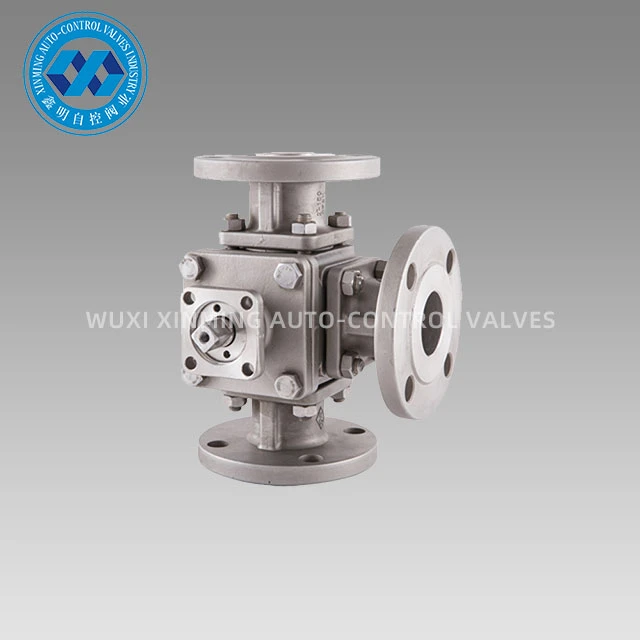
The Three Way Ball Valve has three ports and can be used to divert or mix the flow of fluid. It provides more flexibility in fluid control systems and is commonly used in applications such as heating, ventilation, and air - conditioning (HVAC) systems.
The Ceramic Ball Valve is designed with ceramic components, which offer excellent wear resistance and chemical resistance. These valves are ideal for applications involving abrasive or corrosive fluids.
Conclusion
In conclusion, the relationship between the valve opening and the flow rate in a thread ball valve is a complex but important aspect of fluid control. As a thread ball valve supplier, I understand the significance of providing valves that offer reliable and predictable flow control. By considering the factors that affect this relationship and selecting the appropriate valve for the application, users can ensure efficient and safe operation of their fluid systems.
If you are in need of high - quality thread ball valves or have any questions regarding valve selection and flow control, I encourage you to reach out for a procurement discussion. Our team of experts is ready to assist you in finding the best solutions for your specific needs.

References
- Miller, D. S. (1990). Internal Flow Systems. BHRA Fluid Engineering.
- Crane Co. (1988). Flow of Fluids Through Valves, Fittings, and Pipe. Technical Paper No. 410.