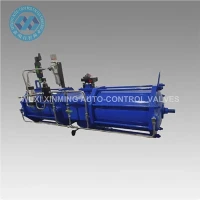
Last month, I was standing in a muddy valve pit at a remote water transfer station, watching a maintenance guy kick the tire of a pickup truck in frustration. He was pointing at a 90-degree pneumatic actuator on a butterfly valve that was taking nearly 40 seconds to close.
"We bought the pneumatic one because it was cheaper," he told me. "But the air compressor is 800 meters away. By the time the air gets here, the pressure drops so much the actuator just crawls."
As a technical engineer who spends half my life on the shop floor at WUXI XINMING AUTO-CONTROL VALVES INDUSTRY CO., LTD. and the other half troubleshooting on client sites, I see this exact scenario all the time. The debate between a 90-degree pneumatic actuator and an electric actuator isn't about which one is "better" in a vacuum. It's about which one survives your specific plant infrastructure.
Brochures will give you spec sheets. I'm going to give you the field reality. Here is how we actually make this choice when we are standing in front of the pipeline.
1. The Infrastructure Reality: Air Lines vs. Power Cables
Let's be blunt: a pneumatic actuator is only as good as the air supply feeding it.
In that remote water station I mentioned, the client saved $500 on the actuator but spent $4,000 laying insulated air tubing across the site, only to suffer from pressure drops. If your valve is located far from a reliable, high-capacity air compressor, or if you are automating a scattered pipeline network, running air lines is a logistical and financial nightmare. In these cases, an electric 90-degree actuator is the undisputed winner. You just pull a power cable, wire it up, and it works.
However, if your plant already has a robust, centralized instrument air system (typically 5 to 7 bar) and the valves are clustered together, pneumatic is faster to install and significantly cheaper upfront.
2. The "Fail-Safe" Factor: What Happens When Things Go Wrong?
This is where the physics of the two technologies completely diverge, and it's usually the deciding factor for safety-critical applications.
A few years ago, a chemical plant called us in a panic. A grid fluctuation caused a momentary power dip. Their electric quarter-turn actuators on the cooling water lines simply stopped where they were (fail-in-place). The reactors started overheating.
We replaced them with spring-return pneumatic actuators. Why? Because pneumatics can be equipped with a spring package. If the plant loses power or loses air supply, the stored mechanical energy in the springs slams the valve into the safe position (fully open or fully closed) in 2 to 3 seconds.
If your process requires a guaranteed fail-safe position during an emergency, a standard electric actuator won't cut it unless you buy a very expensive, heavy battery-backup system. For fail-safe, 90-degree pneumatic is the industry standard for a reason.
3. Hazardous Areas and Explosion-Proofing
If you are automating valves in an oil and gas facility, a paint shop, or a chemical plant with combustible dust, you are dealing with explosive atmospheres (Zone 1 or Zone 2).
I was reviewing a P&ID for a pharmaceutical client who specified electric actuators for their solvent recovery skid. When we priced it out, the explosion-proof (ATEX/IECEx) electric actuators were massive. They weighed over 80kg each, requiring heavily reinforced mounting brackets, and cost three times as much as standard models.
I asked the client, "Do you have instrument air on this skid?" They did.
I immediately swapped the spec to pneumatic 90-degree actuators. Because pneumatics don't use electricity to move, they are intrinsically safe. You don't need the heavy, expensive explosion-proof enclosures. We saved the client thousands of dollars, and the actuators were light enough for two guys to carry up the scaffolding without a crane.
4. Precision and Modulation
There is one area where electric actuators completely dominate: precise throttling.
If you need a ball valve to sit exactly at 43.5 degrees open to maintain a specific flow rate, and you need it to adjust continuously based on a 4-20mA signal from your PLC, an electric actuator with an integrated positioner is incredibly smooth and accurate.
Can pneumatics modulate? Yes, by adding a positioner and air lock valves. But they will always have a slight "hunting" or jittery movement because of the compressibility of air. If your process demands ultra-precise, rock-steady modulation, go with electric. If it's just simple open/close (on/off) duty, pneumatic is all you need.
An Engineer's Honest Advice
When clients ask me, "Which one should I buy?" my first question is always: "What utilities do you actually have at the valve location, and what happens if the power goes out?"
Don't choose based on the catalog price. Choose based on your plant's reality.
Choose Electric if you have no air supply, the valve is remote, or you need ultra-precise modulation.
Choose 90-Degree Pneumatic if you have instrument air, you need a fast fail-safe (spring return), you are in an explosive atmosphere, or you want to save on upfront capital costs.
At WUXI XINMING AUTO-CONTROL VALVES INDUSTRY CO., LTD., we manufacture both. We don't push one over the other. We just want your valve to work reliably on a Sunday night when you aren't there to watch it.
If you are struggling to choose between pneumatic and electric for your next valve automation project, send us your P&ID, site utility conditions, and process requirements. Our engineering team will give you a practical, no-nonsense recommendation tailored to your actual site conditions.
Contact Xinming today, and let's get your valve automation right the first time.