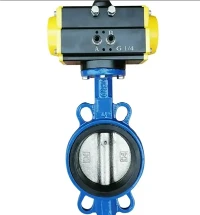
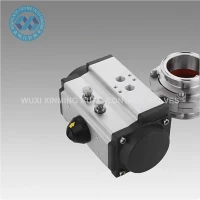
At WUXI XINMING AUTO-CONTROL VALVES INDUSTRY CO., LTD., we have spent years working with customers across water treatment, chemical processing, power generation, food manufacturing, and various industrial automation sectors. During project discussions, one question comes up repeatedly:
"When should we use a spring return pneumatic actuator instead of a double-acting actuator?"
The answer often depends on safety requirements.
In industrial environments, unexpected power failures, air supply interruptions, or emergency shutdown situations can occur without warning. When these events happen, certain valves must automatically move to a predetermined safe position. This is exactly where spring return pneumatic actuators demonstrate their value.
Based on our experience supporting automation projects, spring return actuators are widely used in applications where fail-safe operation is critical.
What Is a Spring Return Pneumatic Actuator?
A spring return pneumatic actuator uses compressed air to move the actuator in one direction while an internal spring provides the force for the return movement.
When air pressure is applied, the actuator rotates or moves the valve to the operating position. Once the air supply is removed, the spring automatically returns the actuator to its preset fail-safe position.
Depending on process requirements, the actuator can be configured as:
- Fail Open
- Fail Close
- Fail Last Position
This simple yet reliable design makes spring return actuators a preferred solution for safety-related automation systems.
Application 1: Emergency Shutdown Systems
One of the most common applications we encounter is emergency shutdown systems.
Several years ago, we worked with a chemical processing customer that needed automated butterfly valves installed on a solvent transfer pipeline. The engineering team emphasized that if compressed air or electrical control signals were lost, the valves had to close immediately to prevent hazardous material movement.
In this scenario, spring return pneumatic actuators were the obvious choice.
When the control signal is interrupted:
- Air pressure is released
- The spring automatically activates
- The valve returns to the closed position
- Product flow is safely isolated
For facilities handling chemicals, fuels, or hazardous liquids, this automatic response can significantly reduce operational risks.
Industries Using ESD Systems
- Chemical plants
- Petrochemical facilities
- Oil and gas terminals
- Refining operations
- Hazardous material storage facilities
Application 2: Water Treatment Plants
Water treatment projects represent a large portion of the automation solutions we support.
In municipal and industrial water treatment systems, valves are often installed in:
- Filter systems
- Backwash lines
- Chemical dosing systems
- Sludge treatment processes
- Clean water distribution networks
A situation we frequently observe occurs during power outages. Operators need confidence that critical valves will move to the correct position without manual intervention.
For example, in chemical dosing systems, a fail-close spring return actuator can prevent uncontrolled chemical injection when the control system loses power.
This level of protection helps maintain process stability while reducing operational concerns for plant personnel.
Application 3: Steam and Thermal Energy Systems
Steam systems often operate under elevated temperature and pressure conditions.
In one thermal energy project, the customer required automatic shutoff capability for steam isolation valves serving process equipment. Their maintenance manager explained that manual valve intervention during emergency situations could expose workers to unnecessary risks.
Spring return actuators provided a straightforward solution.
When air pressure is lost:
- The actuator automatically returns
- The valve isolates the steam source
- Downstream equipment receives additional protection
This application is common in:
- Power plants
- Industrial boilers
- District heating systems
- Manufacturing facilities using process steam
Application 4: Fire Protection and Safety Systems
Safety-related systems often require fail-safe valve operation.
Fire water systems, sprinkler networks, and emergency cooling systems may depend on valves automatically opening or closing under abnormal conditions.
In these applications, engineers generally prioritize reliability over operational complexity.
A spring return actuator's mechanical return mechanism provides an additional layer of confidence because the fail-safe action does not depend on continuous external power.
For critical infrastructure, this feature is often a key specification requirement.
Application 5: Chemical Dosing and Process Control
Chemical dosing processes require precise flow management.
Whether handling acids, alkalis, disinfectants, or specialty chemicals, operators need assurance that chemical flow can be stopped immediately if necessary.
We have seen many customers choose spring return actuators for:
- Acid dosing systems
- Chlorination systems
- pH adjustment systems
- Industrial wastewater treatment
In these applications, a fail-close configuration helps prevent overdosing and protects downstream equipment.
Application 6: Food and Beverage Manufacturing
Food processing facilities place significant emphasis on operational safety and process consistency.
During discussions with food industry clients, concerns often focus on preventing contamination and maintaining production integrity during unexpected shutdowns.
Spring return actuators are commonly installed on:
- CIP systems
- Water supply lines
- Ingredient transfer systems
- Utility service pipelines
If production is interrupted, the actuator automatically returns the valve to its designated safe position, helping operators regain process control more efficiently when operations resume.
Why Many Engineers Prefer Spring Return Actuators
From our experience supporting industrial automation projects, engineers typically select spring return actuators for several practical reasons:
- Improved Safety
The automatic return function helps ensure valves move to a predefined safe position during emergencies.
- Reliable Fail-Safe Operation
The spring mechanism operates independently of external control systems once activated.
- Reduced Operational Risk
Automatic valve positioning can help minimize process upsets caused by power or air supply failures.
- Compliance with Safety Requirements
Many industrial standards and engineering specifications require fail-safe valve operation for critical processes.
- Selecting the Right Spring Return Pneumatic Actuator
Choosing the appropriate actuator involves evaluating several factors:
- Valve type
- Valve torque requirements
- Air supply pressure
- Ambient temperature
- Operating frequency
- Corrosion resistance requirements
- Required fail-safe position
At WUXI XINMING AUTO-CONTROL VALVES INDUSTRY CO., LTD., we regularly assist customers in matching actuators with butterfly valves, ball valves, and other automated valve assemblies. Proper sizing is essential because an undersized actuator may not provide sufficient torque, while excessive oversizing can increase project costs unnecessarily.
Final Thoughts
As industrial automation continues to advance, safety remains a top priority across virtually every industry.
Spring return pneumatic actuators may appear to be a simple mechanical solution, but their ability to automatically move valves to a safe position during unexpected events makes them an important component in modern process control systems.
Over the years, we have seen their value demonstrated repeatedly in water treatment plants, chemical facilities, power stations, manufacturing plants, and countless other industrial applications.
At WUXI XINMING AUTO-CONTROL VALVES INDUSTRY CO., LTD., we believe that reliable automation is not only about improving efficiency-it is also about helping operators maintain safe, stable, and predictable processes. For many critical applications, spring return pneumatic actuators continue to play an essential role in achieving that goal.