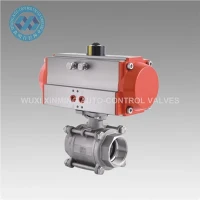
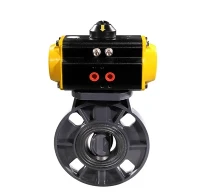
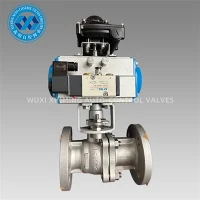
Walk through any chemical processing plant, offshore platform, or pharmaceutical facility, and you will eventually spot a pneumatic actuator that looks like it has been through a war. The housing is pitted, the nameplate is illegible, and the mounting bolts are fused with rust.
At WUXI XINMING AUTO-CONTROL VALVES INDUSTRY CO., LTD., we get called in when these failures cause unplanned shutdowns. The root cause is almost always a mismatch between the actuator material and the environment. This brings us to a critical question we answer daily: What exactly is a stainless steel pneumatic actuator, and why is it the non-negotiable standard for corrosive environments?
What Exactly Is a Stainless Steel Pneumatic Actuator?
To understand the solution, we first need to clear up a common industry misconception. Many suppliers will sell you an actuator with a "stainless steel exterior" but use carbon steel for the internal springs, fasteners, and stem connectors. In a harsh environment, that internal carbon steel will rust from the inside out, seizing the actuator.
A true stainless steel pneumatic actuator (specifically one built for severe corrosion) is constructed entirely from stainless steel alloys-typically 304 or, more commonly, 316 (marine-grade) stainless steel. This includes the cylinder barrel, end caps, tie rods, fasteners, and even the internal spring (which is often coated or made of specialized stainless alloy). It is designed so that no vulnerable carbon steel is exposed to the atmosphere or the process medium.
Why Do Standard Actuators Fail in Corrosive Environments?
Standard rack-and-pinion actuators are usually made of hard-anodized aluminum or epoxy-coated carbon steel. These are excellent, cost-effective choices for water treatment or HVAC systems. But they have a fatal flaw in aggressive environments: they rely on a surface barrier for protection.
Once that anodized layer or epoxy coating gets scratched during installation, or degraded by chemical vapors, the underlying metal is exposed. In the presence of moisture, chlorides, or acids, galvanic and pitting corrosion begins immediately. We have seen aluminum actuators literally disintegrate at the tie-rod threads within six months in a coastal facility, leading to a catastrophic loss of air pressure and valve failure.
Why Stainless Steel is the Ultimate Solution
When we specify a 316 stainless steel pneumatic actuator for a client, we are solving three specific engineering challenges:
1. Resistance to Pitting and Crevice Corrosion
Environments like offshore oil rigs or coastal desalination plants are rich in chloride ions. Chlorides are the enemy of aluminum and standard steel. 316 stainless steel contains molybdenum, which fundamentally alters the metal's crystalline structure to resist chloride pitting. The corrosion resistance isn't a coating; it's intrinsic to the material.
2. Withstanding Aggressive Chemical Washdowns
In a recent project for a food and beverage processing plant, the valves needed to be cleaned daily using high-pressure, high-temperature caustic soda and chlorine-based sanitizers (CIP/SIP processes). The client's previous aluminum actuators were turning white and flaking, risking product contamination. By switching to our full 316 stainless steel actuators, the equipment not only survived the daily chemical baths but could also be高压冲洗 (high-pressure washed) without degrading the surface.
3. Long-Term Mechanical Integrity
Corrosion doesn't just look bad; it changes dimensions. Rust expands, which can bind the piston inside the cylinder or seize the pinion gear. Stainless steel maintains its precise machining tolerances even after years of exposure to acidic vapors in chemical plants, ensuring the valve operates smoothly from day one to year twenty.
Is Stainless Steel Always the Right Choice? (Our Honest Advice)
At WUXI XINMING, we believe in engineering the right solution, not just the most expensive one. Stainless steel actuators cost significantly more than aluminum ones. If your actuator is installed indoors in a dry, climate-controlled warehouse, stainless steel is a waste of your budget. We will always recommend high-quality anodized aluminum for those standard applications to protect your ROI.
But if your actuator is exposed to salt spray, chemical vapors, high humidity, or strict hygiene washdowns, the premium for stainless steel pays for itself by preventing a single unplanned shutdown.
Secure Your Pipeline Against Corrosion
Choosing the right material is the first line of defense for your valve automation system. If you are managing a project in a corrosive environment and need to ensure long-term reliability, don't leave it to guesswork.
Send your specific environmental details to WUXI XINMING AUTO-CONTROL VALVES INDUSTRY CO., LTD. Our engineering team will provide a free, honest material assessment and a customized 316 stainless steel pneumatic actuator solution designed to survive your harshest conditions.
Contact us today to protect your assets and ensure uninterrupted process control.