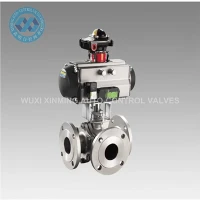
At WUXI XINMING AUTO-CONTROL VALVES INDUSTRY CO., LTD., we work with customers from a wide range of industries, including water treatment, chemical processing, food production, power generation, pharmaceuticals, and general manufacturing. While discussing valve automation solutions, one type of actuator consistently appears in project specifications: the aluminum pneumatic actuator.
Over the years, we have seen countless projects where aluminum rack and pinion pneumatic actuators became the preferred choice due to their balance of durability, corrosion resistance, lightweight construction, and cost-effectiveness.
Many customers initially focus on torque output and valve compatibility. However, after installation and years of operation, they often appreciate another advantage-the ability of aluminum actuators to perform reliably in demanding industrial environments while keeping maintenance requirements relatively low.
In this article, we share some of the most common applications where aluminum pneumatic actuators are widely used and explain why they continue to play an important role in industrial automation.
What Is an Aluminum Pneumatic Actuator?
An aluminum pneumatic actuator is a device that converts compressed air energy into mechanical motion to operate quarter-turn valves such as:
- Butterfly valves
- Ball valves
- Plug valves
- Dampers
Most modern pneumatic actuators use a high-strength aluminum alloy housing combined with internal pistons and rack-and-pinion mechanisms.
The aluminum body offers several practical advantages:
- Lightweight construction
- Excellent corrosion resistance
- Good heat dissipation
- High mechanical strength
- Cost-effective manufacturing
These characteristics make aluminum actuators suitable for a broad range of industrial applications.
1. Water Treatment and Wastewater Treatment Plants
One of the most common industries we serve is water treatment.
In municipal water plants and industrial wastewater facilities, automated valves are installed throughout the process, including:
- Raw water intake systems
- Filtration units
- Backwash systems
- Chemical dosing lines
- Sludge treatment processes
Several years ago, we supplied automated butterfly valves equipped with aluminum pneumatic actuators for a wastewater treatment upgrade project. The customer required equipment capable of operating reliably in a humid environment where exposure to water and treatment chemicals was unavoidable.
The corrosion-resistant aluminum housing proved to be a practical solution, helping ensure long-term operation while minimizing maintenance concerns.
Typical Valves Used
- Pneumatic butterfly valves
- Pneumatic ball valves
- Pneumatic control valves
2. Chemical Processing Facilities
Chemical plants often present challenging operating conditions.
Depending on the process, equipment may be exposed to:
- Corrosive vapors
- Chemical splashes
- High humidity
- Continuous operation
Although stainless steel actuators are sometimes specified for highly aggressive environments, aluminum pneumatic actuators are frequently selected for general chemical applications due to their excellent balance of performance and cost.
We often see aluminum actuators installed on process pipelines controlling:
- Acids
- Alkalis
- Solvents
- Industrial chemicals
When combined with suitable protective coatings, they provide reliable service in many chemical production environments.
3. Food and Beverage Manufacturing
Food processing facilities require automated systems that are efficient, reliable, and easy to maintain.
Many production lines rely on pneumatic actuators to control:
- Water supply systems
- Ingredient transfer pipelines
- Cleaning systems
- Utility services
One food manufacturing customer explained that reducing equipment weight was important because numerous automated valves were mounted on elevated stainless-steel pipe racks.
The lightweight nature of aluminum actuators simplified installation and reduced the overall load on supporting structures.
Common applications include:
- Beverage production lines
- Dairy processing facilities
- Brewing systems
- Food ingredient handling systems
4. Pharmaceutical Manufacturing
The pharmaceutical industry places strong emphasis on cleanliness and process control.
In pharmaceutical plants, pneumatic actuators are commonly used for:
- Purified water systems
- Process utilities
- CIP systems
- Production support equipment
Aluminum pneumatic actuators are often selected because their compact design allows installation in equipment rooms where space is limited.
Additionally, their smooth external surfaces make routine cleaning easier than some heavier industrial alternatives.
5. Power Generation Facilities
Power plants require dependable automation systems capable of operating continuously.
In thermal power and utility applications, aluminum pneumatic actuators are frequently used for:
- Cooling water systems
- Auxiliary process pipelines
- Compressed air systems
- Water treatment units
A customer operating a utility boiler facility once told us that actuator reliability was a higher priority than advanced features. Their maintenance team preferred proven actuator designs that were easy to service and supported by readily available spare parts.
This is one reason rack-and-pinion aluminum actuators remain widely used in power generation environments.
6. General Manufacturing and Industrial Automation
Many industrial automation projects involve hundreds of automated valves throughout a facility.
Common examples include:
- Production process lines
- Utility systems
- Compressed air networks
- Industrial water systems
- Equipment cooling systems
Because aluminum actuators are relatively lightweight and economical, they are often selected when large numbers of automated valves are required.
For plant managers balancing performance and project budgets, this can be an important advantage.
7. Oil Storage and Fuel Handling Systems
In fuel storage terminals and industrial oil handling facilities, pneumatic actuators are frequently used to automate flow control and isolation valves.
Applications may include:
- Diesel transfer systems
- Lubrication oil systems
- Fuel distribution pipelines
- Storage tank connections
Many operators appreciate the fail-safe capabilities available with spring-return aluminum pneumatic actuators, particularly in applications where emergency valve positioning is required.
- Why Aluminum Pneumatic Actuators Are Widely Used
From our experience supporting industrial projects, customers often choose aluminum pneumatic actuators for several practical reasons.
- Lightweight Design
The reduced weight simplifies transportation, installation, and maintenance.
- Corrosion Resistance
Aluminum naturally resists corrosion and performs well in many industrial environments.
- Cost Efficiency
Compared with some alternative materials, aluminum actuators often provide an excellent balance between performance and investment.
- Reliable Operation
Modern rack-and-pinion actuator designs offer consistent torque output and dependable performance over long operating periods.
- Easy Integration
Aluminum pneumatic actuators are widely compatible with:
- ISO 5211 valve mounting standards
- NAMUR accessories
- Solenoid valves
- Limit switch boxes
- Positioners
Selecting the Right Aluminum Pneumatic Actuator
Before selecting an actuator, we generally recommend evaluating:
- Valve torque requirements
- Operating pressure
- Environmental conditions
- Temperature range
- Cycle frequency
- Fail-safe requirements
- Accessory compatibility
A properly selected actuator not only improves operational efficiency but can also help reduce maintenance costs over the life of the equipment.
Final Thoughts
Aluminum pneumatic actuators continue to be one of the most widely used solutions in industrial automation. Their combination of lightweight construction, corrosion resistance, reliable performance, and economic value makes them suitable for a wide variety of industries.
At WUXI XINMING AUTO-CONTROL VALVES INDUSTRY CO., LTD., we have supplied pneumatic actuator solutions for customers across water treatment, chemical processing, food production, pharmaceutical manufacturing, power generation, and general industrial automation projects. Through these experiences, we have seen how the right actuator selection contributes not only to process efficiency but also to long-term operational reliability.
For facilities seeking dependable valve automation solutions, aluminum pneumatic actuators remain a practical and proven choice in many industrial applications.