The flow coefficient, often denoted as Cv, is a crucial parameter when it comes to understanding the performance of a pneumatic ball valve. As a leading supplier of pneumatic ball valves, I've witnessed firsthand the importance of this coefficient in various industrial applications. In this blog post, I'll delve into what the flow coefficient of a pneumatic ball valve is, why it matters, and how it impacts the functionality of these valves.
What is the Flow Coefficient (Cv)?
The flow coefficient (Cv) is a measurement that indicates the amount of water (in US gallons per minute) at 60°F that will flow through a fully open valve with a pressure drop of 1 psi across the valve. In simpler terms, it's a way to quantify the valve's capacity to allow fluid to pass through it. A higher Cv value means the valve can handle a greater flow rate with a lower pressure drop, while a lower Cv value indicates a more restrictive valve.

Let's take a practical example to illustrate this concept. Imagine you have two pneumatic ball valves, Valve A and Valve B. Valve A has a Cv of 10, and Valve B has a Cv of 20. If you apply the same pressure drop across both valves, Valve B will allow twice as much water to flow through it compared to Valve A. This is because Valve B has a higher flow coefficient, meaning it offers less resistance to the flow of fluid.
Why is the Flow Coefficient Important?
The flow coefficient is a critical factor in valve selection for several reasons. Firstly, it helps engineers and designers determine the appropriate valve size for a specific application. If the flow coefficient of a valve is too low for the required flow rate, it can lead to excessive pressure drops, increased energy consumption, and potential damage to the valve and other components in the system. On the other hand, if the flow coefficient is too high, the valve may be oversized, resulting in unnecessary costs and inefficient operation.
Secondly, the flow coefficient affects the control performance of the valve. In applications where precise flow control is required, such as in chemical processing or water treatment plants, a valve with the right flow coefficient is essential. A valve with a well-matched Cv value can provide accurate and stable flow control, ensuring that the process operates smoothly and efficiently.
Finally, the flow coefficient is also important for system design and optimization. By understanding the flow characteristics of different valves, engineers can design piping systems that minimize pressure losses and maximize overall system efficiency. This can lead to significant cost savings in terms of energy consumption and maintenance.
Factors Affecting the Flow Coefficient of a Pneumatic Ball Valve
Several factors can influence the flow coefficient of a pneumatic ball valve. One of the most significant factors is the valve size. Generally, larger valves have higher flow coefficients because they offer a larger cross-sectional area for fluid to flow through. However, it's important to note that the relationship between valve size and flow coefficient is not always linear. Other factors, such as the valve design, the type of ball (full port or reduced port), and the seat material, can also affect the flow coefficient.
The valve design plays a crucial role in determining the flow coefficient. For example, a full port ball valve has a larger flow path compared to a reduced port ball valve, resulting in a higher flow coefficient. The shape of the ball and the internal passages of the valve can also impact the flow characteristics. Valves with smooth, streamlined internal surfaces tend to have lower flow resistance and higher flow coefficients.
The type of seat material used in the valve can also affect the flow coefficient. Soft seats, such as those made of rubber or Teflon, can provide a tight seal but may also introduce some flow resistance. Hard seats, on the other hand, offer less flow resistance but may require more precise machining to ensure a proper seal.
Calculating the Flow Coefficient
Calculating the flow coefficient of a pneumatic ball valve can be a complex process, as it involves considering several factors such as the valve size, design, and operating conditions. However, there are some standard methods and equations that can be used to estimate the Cv value.
One of the most common methods is the use of manufacturer's data. Most valve manufacturers provide Cv values for their valves based on standardized testing procedures. These values can be found in the valve's technical specifications or catalogs. It's important to note that these values are typically based on ideal conditions and may need to be adjusted for actual operating conditions.
Another method is to use empirical equations. There are several equations available in the literature that can be used to calculate the flow coefficient based on the valve geometry and operating conditions. These equations take into account factors such as the valve size, the pressure drop across the valve, and the fluid properties. However, these equations may have limitations and may not be accurate for all types of valves and operating conditions.
Flow Coefficient and Valve Selection
When selecting a pneumatic ball valve for a specific application, it's essential to consider the flow coefficient. The first step is to determine the required flow rate and the allowable pressure drop for the system. Once these parameters are known, you can use the manufacturer's data or empirical equations to select a valve with an appropriate Cv value.
It's also important to consider other factors such as the valve's pressure rating, temperature rating, and material compatibility. These factors can affect the valve's performance and durability in the specific application. For example, if the application involves high-pressure or high-temperature fluids, you'll need to select a valve with a suitable pressure and temperature rating.
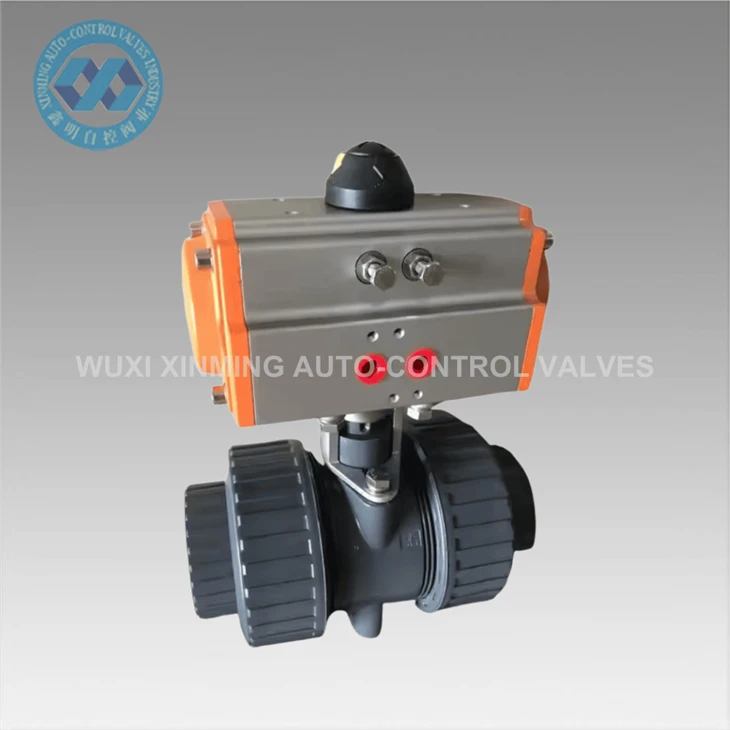
As a pneumatic ball valve supplier, we offer a wide range of valves with different flow coefficients to meet the diverse needs of our customers. Our Double-union PVC Ball Valve With Double Acting Pneumatic Actuator is a popular choice for applications requiring corrosion resistance and reliable flow control. It has a high flow coefficient, allowing for efficient fluid flow even in large-scale systems.
Our Pneumatic Actuator Stainless Steel Flange Ball Valve is another excellent option for applications where durability and high-pressure resistance are essential. It features a robust design and a high flow coefficient, making it suitable for a variety of industrial applications.
For applications requiring three-way flow control, our Pneumatic Actuated Three-Way Stainless Steel Ball Valve is a top choice. It offers precise flow control and a high flow coefficient, ensuring efficient operation in complex piping systems.
Conclusion
In conclusion, the flow coefficient is a vital parameter when it comes to understanding the performance of a pneumatic ball valve. It plays a crucial role in valve selection, system design, and flow control. By understanding the factors that affect the flow coefficient and how to calculate it, engineers and designers can make informed decisions when selecting a valve for a specific application.
As a pneumatic ball valve supplier, we are committed to providing our customers with high-quality valves that offer excellent flow performance. If you have any questions about the flow coefficient or need assistance in selecting the right valve for your application, please don't hesitate to contact us. We have a team of experienced engineers who can provide you with expert advice and guidance. Let's work together to ensure that your system operates efficiently and reliably.
References
- Crane Co., "Flow of Fluids Through Valves, Fittings, and Pipe," Technical Paper No. 410.
- ASME B16.34, "Valves - Flanged, Threaded, and Welding End."
- ISO 5167, "Measurement of Fluid Flow by Means of Orifice Plates, Nozzles and Venturi Tubes Inserted in Circular Cross - Section Conduits Running Full."