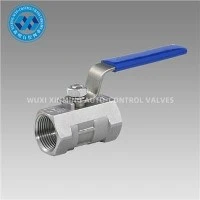
The flow coefficient, often denoted as Cv, is a crucial parameter when it comes to understanding the performance of a thread ball valve. As a reputable thread ball valve supplier, I'm well - versed in the technicalities of these valves and the significance of the flow coefficient.


Understanding the Flow Coefficient
The flow coefficient (Cv) of a valve is a measure of its capacity to pass fluid. It is defined as the number of US gallons per minute (GPM) of water at 60°F that will flow through a valve with a pressure drop of 1 pound per square inch (psi) across the valve. In simpler terms, it gives us an idea of how much fluid a valve can handle under specific pressure conditions.
Mathematically, the relationship between flow rate (Q), pressure drop (ΔP), and flow coefficient (Cv) can be expressed by the following formula for liquid flow:
[Q = C_{v}\sqrt{\frac{\Delta P}{S}}]
Where:
- (Q) is the flow rate in GPM
- (C_{v}) is the flow coefficient
- (\Delta P) is the pressure drop across the valve in psi
- (S) is the specific gravity of the fluid. For water at 60°F, (S = 1)
For gas flow, the formula is more complex and takes into account factors such as the gas's specific gravity, compressibility factor, and the ratio of specific heats.
Factors Affecting the Flow Coefficient of a Thread Ball Valve
Valve Size
One of the most significant factors influencing the flow coefficient is the size of the valve. Larger valves generally have higher flow coefficients because they offer a larger cross - sectional area for the fluid to pass through. For example, a 2 - inch thread ball valve will typically have a much higher Cv value than a 1 - inch valve, all other factors being equal.
Ball Port Size
The size of the ball port also plays a vital role. There are different types of ball ports, such as full - port and reduced - port. A full - port ball valve has a ball port that is the same size as the pipe diameter, allowing for maximum flow and a relatively high flow coefficient. On the other hand, a reduced - port ball valve has a smaller ball port, which restricts the flow and results in a lower Cv value.
Valve Design and Geometry
The internal design and geometry of the valve can affect the flow coefficient. A well - designed valve with smooth internal surfaces and minimal flow restrictions will have a higher Cv. For instance, valves with streamlined flow paths reduce turbulence and pressure losses, thereby increasing the flow capacity and the flow coefficient.
Valve Trim Material
The material of the valve trim can also have an impact. Some materials may have a rougher surface finish, which can cause more friction and turbulence in the fluid flow, reducing the flow coefficient. Smooth - surfaced materials, on the other hand, promote better flow and can result in a higher Cv.
Importance of the Flow Coefficient in Thread Ball Valve Applications
System Design
In fluid handling systems, the flow coefficient is essential for proper system design. Engineers need to select the right valve with an appropriate Cv value to ensure that the system can achieve the desired flow rate. If a valve with a too - low Cv is selected, it may not be able to deliver the required amount of fluid, leading to inefficiencies or even system failures.
Energy Efficiency
A valve with a high flow coefficient can help improve energy efficiency. Since it allows for a greater flow of fluid with less pressure drop, less energy is required to pump the fluid through the system. This can result in significant cost savings over the long term, especially in large - scale industrial applications.
Process Control
In processes where precise flow control is required, the flow coefficient is a key parameter. By knowing the Cv of a valve, operators can accurately predict and control the flow rate of the fluid, ensuring consistent product quality and process performance.
Our Thread Ball Valve Offerings and Flow Coefficients
As a thread ball valve supplier, we offer a wide range of valves with different flow coefficients to meet the diverse needs of our customers. Our product portfolio includes:
- Intelligent - driven Double - acting Pneumatic Plastic Actuator Ball Valve For Precise Opening Control: This valve is designed for applications where precise control of the flow is required. It has a well - engineered internal design that maximizes the flow coefficient while providing accurate opening control.
- Sanitary Grade Stainless Steel 304 316 Ball Valve: Ideal for industries such as food and beverage, pharmaceuticals, and biotechnology, these valves are made from high - quality stainless steel. The smooth internal surfaces of the valve contribute to a relatively high flow coefficient, ensuring efficient fluid transfer while maintaining sanitary conditions.
- Pneumatic Actuated Ball Valve: Our pneumatic actuated ball valves are known for their reliability and high performance. They are available in different sizes and port configurations, allowing customers to choose a valve with the appropriate flow coefficient for their specific application.
Determining the Right Flow Coefficient for Your Application
When selecting a thread ball valve, it is crucial to determine the right flow coefficient for your application. Here are the steps you can follow:
Calculate the Required Flow Rate
First, you need to calculate the required flow rate of the fluid in your system. This can be based on the process requirements, such as the amount of fluid needed to be transferred per unit of time.
Determine the Pressure Drop
Next, estimate the pressure drop across the valve. This depends on factors such as the length of the piping, the number of fittings, and the fluid velocity.
Use the Flow Coefficient Formula
Once you have the flow rate and pressure drop values, you can use the flow coefficient formula to calculate the required Cv. Make sure to take into account the specific gravity of the fluid if it is not water.
Select the Valve
Based on the calculated Cv value, select a valve from our product range that has a suitable flow coefficient. Our technical team is always available to assist you in making the right choice.
Conclusion
The flow coefficient of a thread ball valve is a critical parameter that affects its performance and suitability for different applications. As a thread ball valve supplier, we understand the importance of providing valves with accurate and reliable flow coefficients. Our diverse product range, including the Intelligent - driven Double - acting Pneumatic Plastic Actuator Ball Valve For Precise Opening Control, Sanitary Grade Stainless Steel 304 316 Ball Valve, and Pneumatic Actuated Ball Valve, ensures that we can meet the unique needs of our customers.
If you are in the market for a thread ball valve and need help selecting the right one based on the flow coefficient or have any other questions, we encourage you to contact us for a detailed discussion and to start the procurement process. Our team of experts is ready to assist you in finding the perfect valve solution for your application.
References
- Crane Technical Paper No. 410, "Flow of Fluids Through Valves, Fittings, and Pipe"
- Valves Handbook, edited by Robert W. McKetta