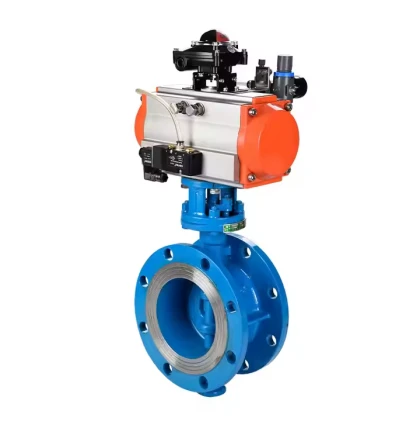
As a supplier of WCB Butterfly Valves, I often encounter inquiries regarding the flow coefficient of these valves. The flow coefficient, commonly denoted as Cv, is a crucial parameter in the field of fluid control. It serves as a measure of a valve's capacity to pass fluid under specific conditions. Understanding the flow coefficient of a WCB Butterfly Valve is essential for engineers, system designers, and end - users alike, as it directly impacts the performance and efficiency of fluid systems.
What is the Flow Coefficient (Cv)?
The flow coefficient Cv is defined as the number of US gallons per minute (GPM) of water at 60°F that will flow through a valve with a pressure drop of 1 psi across the valve. In other words, it quantifies the valve's ability to allow fluid to pass through. A higher Cv value indicates that the valve can pass a greater volume of fluid for a given pressure drop.
For a WCB Butterfly Valve, the flow coefficient is influenced by several factors. Firstly, the size of the valve plays a significant role. Larger - sized valves generally have higher Cv values because they offer a larger flow area. As the diameter of the valve increases, the cross - sectional area through which the fluid can flow also increases, allowing more fluid to pass through per unit time.
Secondly, the valve's disc position affects the flow coefficient. A WCB Butterfly Valve operates by rotating a disc within the valve body. When the disc is fully open, the valve offers the least resistance to flow, and the Cv value is at its maximum. As the disc is gradually closed, the flow area is reduced, and the Cv value decreases accordingly.
The design of the valve body and the disc also impacts the flow coefficient. Well - designed WCB Butterfly Valves with streamlined shapes can minimize flow restrictions and turbulence, resulting in higher Cv values. Additionally, the material of the valve components can have an indirect effect on the flow coefficient. For example, a valve with smooth internal surfaces will have less frictional resistance to flow, which can contribute to a relatively higher Cv value.

Calculating the Flow Coefficient of a WCB Butterfly Valve
Calculating the exact flow coefficient of a WCB Butterfly Valve can be a complex process. It typically involves laboratory testing under controlled conditions. Manufacturers usually conduct tests on their valves to determine the Cv values for different valve sizes and disc positions. These values are then provided in the valve's technical documentation.
In some cases, empirical formulas can be used to estimate the flow coefficient. One common formula for estimating the Cv of a butterfly valve is based on the valve's size and the pressure drop across the valve. However, these formulas are approximations and may not be as accurate as actual test results.
The general relationship between flow rate (Q), pressure drop (ΔP), and flow coefficient (Cv) is given by the following equation:
[Q = Cv\sqrt{\frac{\Delta P}{SG}}]
where Q is the flow rate in GPM, ΔP is the pressure drop across the valve in psi, and SG is the specific gravity of the fluid. For water at 60°F, SG = 1.
Importance of the Flow Coefficient in System Design
When designing a fluid system that incorporates a WCB Butterfly Valve, the flow coefficient is a key consideration. It helps engineers determine the appropriate valve size for a given application. If the Cv value of the selected valve is too low, the valve may not be able to handle the required flow rate, leading to excessive pressure drops and reduced system efficiency. On the other hand, if the Cv value is too high, the valve may be oversized, which can result in higher costs and potential operational issues.
For example, in a water distribution system, accurate knowledge of the flow coefficient is essential for ensuring that the right amount of water is delivered to different parts of the system. In a chemical processing plant, the flow coefficient of the WCB Butterfly Valve is crucial for controlling the flow of various chemicals, maintaining proper reaction conditions, and ensuring the safety of the process.
Applications and the Role of Flow Coefficient
WCB Butterfly Valves are widely used in various industries, including water treatment, oil and gas, chemical processing, and HVAC systems. In each of these applications, the flow coefficient plays a vital role.
In water treatment plants, WCB Butterfly Valves are used to control the flow of water during different treatment processes. The flow coefficient helps in regulating the flow rate to ensure that the water is treated effectively. For instance, during the filtration process, the valve's Cv value is adjusted to maintain a consistent flow rate through the filters, preventing over - or under - filtration.
In the oil and gas industry, these valves are used in pipelines to control the flow of crude oil, natural gas, and refined products. The flow coefficient is critical for optimizing the flow of these fluids, minimizing pressure losses, and ensuring the safe and efficient operation of the pipeline system.
In chemical processing plants, WCB Butterfly Valves are used to handle a wide range of chemicals. The flow coefficient is used to control the precise amount of chemicals being added to reactions, ensuring the quality and consistency of the final products.
Related Products and Their Significance
As a supplier, we also offer a range of related products such as the Stainless Steel SS304 316L Pneumatic Butterfly Valve Butterfly Valve. These valves are made of high - quality stainless steel, which provides excellent corrosion resistance. The pneumatic actuation allows for precise control of the valve's disc position, which in turn affects the flow coefficient. By adjusting the pneumatic pressure, the valve can be opened or closed to achieve the desired flow rate.
The Pneumatic Butterfly Valve: Key Component For Optimal Pneumatic System Performance is another important product in our portfolio. Pneumatic butterfly valves are known for their fast response times and reliable operation. In a pneumatic system, the flow coefficient of these valves is crucial for maintaining the proper balance of air or other gases, ensuring the efficient operation of the entire system.
Our Pneumatic Sanitary Butterfly Valve With Low Leakage Rate is specifically designed for applications where hygiene is of utmost importance, such as in the food and beverage industry and pharmaceutical manufacturing. The low leakage rate ensures that there is no contamination of the fluid being handled. The flow coefficient of these valves is carefully calibrated to meet the specific flow requirements of these industries while maintaining high levels of cleanliness.
Conclusion
In conclusion, the flow coefficient of a WCB Butterfly Valve is a fundamental parameter that significantly impacts the performance of fluid systems. It is influenced by factors such as valve size, disc position, and valve design. Understanding the flow coefficient is essential for proper valve selection and system design.
As a supplier of WCB Butterfly Valves and related products, we are committed to providing high - quality valves with accurate flow coefficient data. Our products are designed to meet the diverse needs of different industries, ensuring optimal performance and efficiency.
If you are in need of WCB Butterfly Valves or any of our related products, we encourage you to contact us for procurement and further technical discussions. We have a team of experts who can assist you in selecting the right valve for your specific application, taking into account the flow coefficient and other important factors.
References
- Crane Technical Paper No. 410, "Flow of Fluids Through Valves, Fittings, and Pipe".
- Valve Manufacturers Association (VMA) standards and guidelines.
- Perry's Chemical Engineers' Handbook, relevant sections on fluid flow and valve technology.